
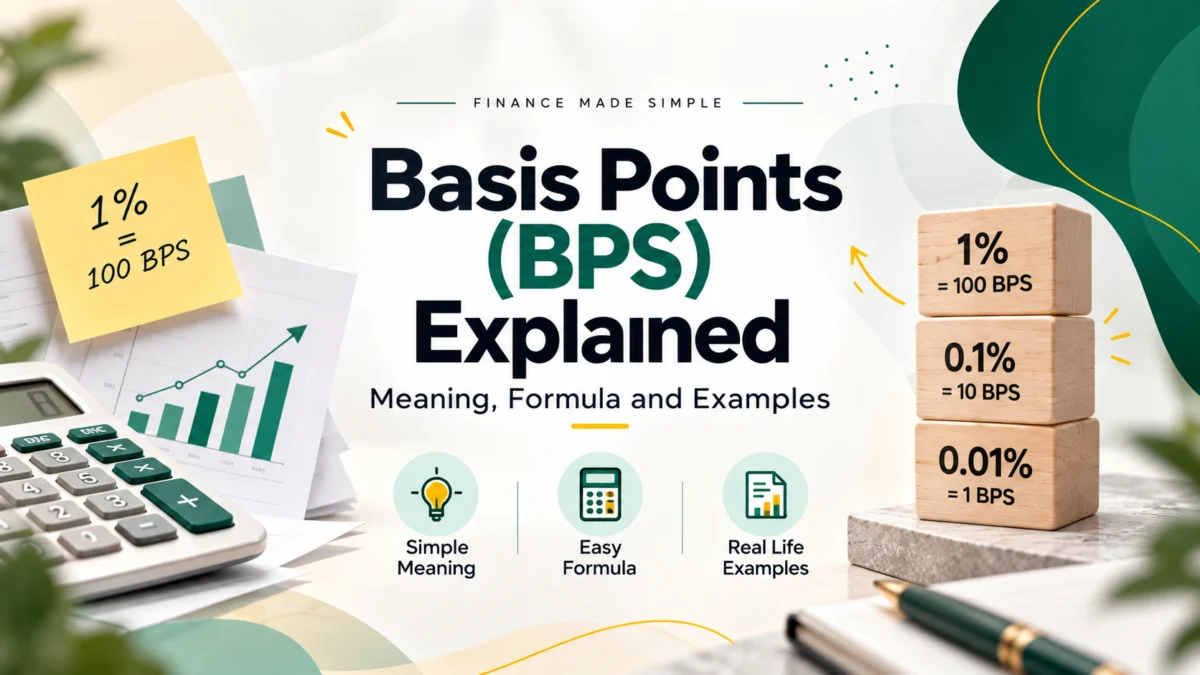
Basis points (BPS) are a standard unit used in finance to describe small changes in interest rates, bond yields, loan rates, investment fees, and other percentage based financial measures. One basis point equals 0.01 percentage point, and 100 basis points equal one percentage point.
For example, if an interest rate rises from 4.50% to 4.75%, the increase is 25 basis points. Understanding basis points helps borrowers, investors, students, and business owners compare financial rates without confusing a percentage point change with a relative percentage change.
This guide explains what basis points mean, how to calculate them, how to convert BPS into percentages, and how they are used in practical financial situations.
Key Highlights
- One basis point equals 0.01 percentage point, or 0.0001 in decimal form.
- 100 basis points equal one percentage point.
- Convert basis points to percentage points by dividing by 100.
- Convert a percentage point change to basis points by multiplying by 100.
- Calculate the difference between two rates by subtracting the original rate from the new rate and multiplying the result by 100.
- Basis points are commonly used for interest rates, mortgage rates, bond yields, loan spreads, and investment fees.
- A basis point change is not the same as a relative percentage change.
What Are Basis Points (BPS)?
A basis point is one hundredth of a percentage point. The abbreviation is commonly written as BP for a single basis point and BPS or bps for multiple basis points.
The unit is useful when a financial rate changes by a small amount. Instead of describing an interest rate increase as 0.25 percentage point, financial professionals may describe it as a 25 basis point increase.
To understand how financial information is recorded and reported, read our guide to what accounting is.
For example, suppose a loan interest rate changes from 6.00% to 6.25%.
The difference is:
6.25% − 6.00% = 0.25 percentage point
0.25 × 100 = 25 basis points
The interest rate has increased by 25 basis points.
According to the U.S. Securities and Exchange Commission’s Investor.gov glossary, a basis point represents one hundredth of a percentage point.
Basis Points at a Glance
| Basis points | Percentage point equivalent | Decimal equivalent |
|---|---|---|
| 1 BPS | 0.01% | 0.0001 |
| 5 BPS | 0.05% | 0.0005 |
| 8 BPS | 0.08% | 0.0008 |
| 10 BPS | 0.10% | 0.0010 |
| 25 BPS | 0.25% | 0.0025 |
| 50 BPS | 0.50% | 0.0050 |
| 75 BPS | 0.75% | 0.0075 |
| 100 BPS | 1.00% | 0.0100 |
| 150 BPS | 1.50% | 0.0150 |
| 200 BPS | 2.00% | 0.0200 |
| 250 BPS | 2.50% | 0.0250 |
| 500 BPS | 5.00% | 0.0500 |
| 1,000 BPS | 10.00% | 0.1000 |
| 10,000 BPS | 100.00% | 1.0000 |
Important: The percentage column represents the percentage point equivalent of the basis point amount. It does not represent the relative percentage change from an original rate.
Basis Points Formula
The correct formula depends on whether you are converting a basis point amount, converting a percentage point change, or comparing two rates.
1. Formula to Convert Basis Points to Percentage Points
Formula:
Percentage point change = Basis points ÷ 100
For example, to convert 75 basis points:
75 ÷ 100 = 0.75
Therefore, 75 basis points equal 0.75 percentage point.
2. Formula to Convert Percentage Points to Basis Points
Formula:
Basis points = Percentage point change × 100
For example, a rate change of 0.35 percentage point equals:
0.35 × 100 = 35 basis points
3. Formula to Calculate the Difference Between Two Rates
Formula:
Basis point change = (New rate − Original rate) × 100
Enter the rates as percentage values, such as 5.75 and 5.25, rather than decimal values such as 0.0575 and 0.0525.
For example:
Original rate = 5.25%
New rate = 5.75%
(5.75 − 5.25) × 100 = 50 basis points
The rate increased by 50 basis points.
A positive answer indicates an increase, while a negative answer indicates a decrease.
The accounting cycle explains how financial transactions move through recording, organizing, and reporting.
Basis Points Calculator
A basis points calculator can help you convert BPS into percentage points or calculate the difference between two financial rates without doing the arithmetic manually.
Use the AccountingMint Basis Points Calculator to:
- Convert basis points into percentage points and decimal form.
- Convert percentage point changes into basis points.
- Compare an original interest rate with a new interest rate.
- Identify whether a rate increased or decreased.
- Understand the size of a rate movement.
Use the Basis Points Calculator to convert basis points to percentage points or calculate the difference between two interest rates.
How to Convert Basis Points to Percentages
To convert basis points to percentage points, divide the basis point value by 100.
Example 1: Convert 10 Basis Points to a Percentage
10 ÷ 100 = 0.10
Therefore, 10 basis points equal 0.10 percentage point.
Example 2: Convert 25 Basis Points to a Percentage
25 ÷ 100 = 0.25
Therefore, 25 basis points equal 0.25 percentage point.
Example 3: Convert 125 Basis Points to a Percentage
125 ÷ 100 = 1.25
Therefore, 125 basis points equal 1.25 percentage points.
Example 4: Convert 0.45 Percentage Point to Basis Points
0.45 × 100 = 45
Therefore, 0.45 percentage point equals 45 basis points.
Convert Basis Points to Decimal Form
When using a rate in a mathematical formula involving a dollar amount, you may need the decimal equivalent.
Formula:
Decimal equivalent = Basis points ÷ 10,000
For example:
75 ÷ 10,000 = 0.0075
Therefore, 75 basis points equal 0.75%, or 0.0075 in decimal form.
Use the percentage form when describing a rate and the decimal form when multiplying a rate by a financial balance.
How to Calculate Basis Points Between Two Interest Rates
To find the difference between two interest rates, subtract the original rate from the new rate and multiply the difference by 100.
Example 1: Interest Rate Increase
Suppose a loan rate increases from 4.50% to 5.00%.
| Detail | Value |
|---|---|
| Original rate | 4.50% |
| New rate | 5.00% |
| Difference | 0.50 percentage point |
| Basis point change | 50 BPS |
Calculation:
(5.00 − 4.50) × 100 = 50 BPS
The rate increased by 50 basis points.
Example 2: Interest Rate Decrease
Suppose a savings account rate falls from 4.75% to 4.40%.
(4.40 − 4.75) × 100 = −35 BPS
The result is negative because the rate decreased by 35 basis points.
Example 3: A Rate Increases by 25 Basis Points
Suppose an interest rate starts at 4.00% and increases by 25 basis points.
25 ÷ 100 = 0.25 percentage point
4.00% + 0.25 percentage point = 4.25%
The new rate is 4.25%.
Example 4: Compare Two Investment Fees
Suppose an investment fund’s annual expense ratio changes from 0.60% to 0.70%.
(0.70 − 0.60) × 100 = 10 BPS
The expense ratio increased by 10 basis points.
On a hypothetical $10,000 balance, a 0.10% annual fee difference equals approximately $10 per year if the balance remains constant and other costs and changes in value are ignored.
For more context on how financial data is presented in markets, explore our guide to the Russell 2000 and FintechZoom.
Real World Uses of Basis Points
Basis points are commonly used to communicate changes in rates, yields, spreads, and financial costs.
1. Federal Reserve Interest Rate Changes
Financial news often reports changes in the federal funds rate in basis points. A hypothetical 25 basis point increase means an increase of 0.25 percentage point.
If a rate changes from 4.00% to 4.25%, the movement is 25 basis points.
A change in a benchmark rate does not mean every consumer loan or savings account rate will change by the same amount. Financial institutions consider additional factors when setting their rates.
2. Mortgage and Loan Rates
Basis points help borrowers compare changes in mortgage rates and other borrowing costs.
For example, a mortgage rate that increases from 6.25% to 6.75% has increased by 50 basis points.
The effect on a borrower’s monthly payment depends on the loan balance, repayment term, loan structure, and other costs.
3. Investment Fund Expense Ratios
Investment funds may express their annual operating expenses as a percentage of assets. Basis points make small differences easier to compare.
For example, a reduction in an expense ratio from 0.70% to 0.60% equals a decrease of 10 basis points.
The actual dollar savings depend on the invested balance and the period for which the lower fee applies.
4. Bond Yields
Bond market participants use basis points to describe changes in bond yields.
If a bond yield rises from 4.20% to 4.55%, the increase is:
(4.55 − 4.20) × 100 = 35 basis points
Bond prices and yields generally move in opposite directions. However, the impact of a yield movement on a particular bond depends on its maturity, coupon, market conditions, and other characteristics.
5. Loan Spreads
A lender may price a loan using a benchmark rate plus a spread.
For example, a loan spread that increases from 175 basis points to 225 basis points has increased by 50 basis points.
The borrower’s total interest rate depends on the benchmark rate and the terms of the loan.
Basis Points vs Percentage Points vs Percentage Change
These three concepts describe different calculations and should not be used interchangeably.
| Term | Meaning | Example |
|---|---|---|
| Basis points | A unit equal to one hundredth of a percentage point | 25 BPS = 0.25 percentage point |
| Percentage points | The arithmetic difference between two percentage values | 5.00% to 5.25% = 0.25 percentage point |
| Relative percentage change | The difference compared with the original value | 5.00% to 5.25% = 5% relative increase |
Why the Difference Matters
Suppose an interest rate rises from 5.00% to 5.50%.
For another comparison of financial methods, see our guide to cash vs accrual accounting.
The absolute rate change is:
5.50% − 5.00% = 0.50 percentage point
0.50 × 100 = 50 basis points
However, the relative increase compared with the original rate is:
(5.50 − 5.00) ÷ 5.00 × 100 = 10%
The rate therefore increased by 50 basis points, or 10% relative to its original level. These figures describe different things.
Why Are Basis Points Used in Finance?
Clearer Interest Rate Communication
Saying that a rate increased by 25 basis points communicates a precise change of 0.25 percentage point.
Easier Comparison of Financial Products
Basis points help borrowers and investors compare changes in interest rates, investment fees, and loan spreads using a common unit.
More Precise Financial Reporting
Financial reports can describe small changes without repeatedly using decimal percentages.
Understanding the Effect on Large Balances
Even a small rate difference can matter when applied to a large loan or investment balance. The actual financial impact depends on the applicable balance, time period, and contract terms.
Common Mistakes When Calculating Basis Points
Confusing Basis Points With a Relative Percentage Increase
A 100 basis point increase equals one percentage point, not a 100% relative increase.
Using the Wrong Conversion Formula
Divide basis points by 100 to convert them to percentage points. Multiply a percentage point change by 100 to convert it to basis points.
Forgetting the Starting Rate
A 50 basis point increase does not mean the new interest rate is 0.50%.
If the original rate is 4.00%, an increase of 50 basis points produces a new rate of 4.50%.
Mixing Up Percentage Points and Relative Percentage Change
A change from 4.00% to 4.50% equals 0.50 percentage point, or 50 basis points. The relative increase compared with the original 4.00% rate is 12.5%.
Assuming Every Financial Product Changes Equally
A benchmark rate change may influence mortgages, savings accounts, and bonds differently. The effect depends on the product and its terms.
Frequently Asked Questions
What does BPS mean in finance?
BPS stands for basis points. It is a unit used to express small changes in interest rates and other percentage based financial measures. One basis point equals 0.01 percentage point.
How much is one basis point?
One basis point equals 0.01 percentage point, or 0.0001 in decimal form.
How many basis points equal 1%?
One percentage point equals 100 basis points. For example, 1.00% is equivalent to 100 basis points.
What is 10 basis points as a percentage?
Ten basis points equal 0.10 percentage point because 10 divided by 100 equals 0.10.
What is 25 basis points as a percentage?
Twenty five basis points equal 0.25 percentage point.
How do you convert basis points to percentages?
Divide the number of basis points by 100. For example, 75 basis points divided by 100 equals 0.75 percentage point.
How do you calculate basis points between two interest rates?
Subtract the original rate from the new rate and multiply the difference by 100. If a rate rises from 5.00% to 5.25%, the increase is 25 basis points.
Is a 25 basis point change significant?
A 25 basis point change equals 0.25 percentage point. Whether it is financially significant depends on the original rate, the balance involved, the time period, and the type of financial product.
What is the difference between basis points and percentage change?
Basis points generally express the absolute difference between two percentage rates. Relative percentage change measures that difference in relation to the original rate.
How do basis points affect a loan payment?
A rate change may affect borrowing costs, but the payment impact depends on the loan balance, repayment term, rate structure, and lender terms. A basis point conversion alone does not calculate a complete loan payment.
Final Thoughts
Basis points provide a clear way to describe small changes in interest rates, bond yields, loan spreads, and investment fees. Remember that one basis point equals 0.01 percentage point and that 100 basis points equal one percentage point.
To calculate a rate change, subtract the original rate from the new rate and multiply the difference by 100. To convert a basis point amount into percentage points, divide by 100.
For quick calculations, use the AccountingMint Basis Points Calculator once it is available. Understanding these conversions can help you interpret financial news and compare rates without confusing percentage point changes with relative percentage changes.
Continue learning with our guides to bookkeeping and accounting vs bookkeeping to understand how financial records support business reporting.
For quick calculations, use our Basis Points Calculator to convert BPS, compare interest rates, and understand rate changes.
Sources