
Bookkeeping is the process of recording, organizing, classifying, and maintaining the financial transactions of a business. It creates an organized record of money coming into and going out of a business and provides the financial information needed for accounting, tax preparation, reporting, and business decisions.
Every business has financial activity. A customer may pay an invoice, a business may purchase supplies, an employee may receive wages, or the company may pay for software, rent, insurance, or other operating costs. Bookkeeping helps make sure these transactions are recorded properly.
For a small business owner, bookkeeping is more than entering numbers into a spreadsheet or accounting system. Good bookkeeping helps answer important questions such as:
How much money did the business earn?
How much did the business spend?
Who still owes the business money?
What bills does the business need to pay?
How much cash is available?
Is the business operating at a profit?
Are the financial records complete and accurate?
Bookkeeping also provides the organized financial records that accountants can use to prepare reports, analyze business performance, and support tax related work.
The Internal Revenue Service recommends that businesses maintain a recordkeeping system that clearly shows income and expenses and keeps supporting documents for business transactions.
This guide explains what bookkeeping means, how bookkeeping works, the main types of bookkeeping, bookkeeping examples, bookkeeping responsibilities, bookkeeping for small businesses, and the difference between bookkeeping and accounting.
Key Highlights
- Bookkeeping is the process of recording and organizing business financial transactions.
- It helps businesses track income, expenses, assets, liabilities, and other financial activity.
- Single entry and double entry are the two main bookkeeping systems.
- Bookkeeping commonly includes transaction recording, categorization, invoicing, bill tracking, and bank reconciliation.
- Accurate bookkeeping provides reliable information for financial reporting and tax preparation.
- Small businesses can manage bookkeeping themselves, use accounting software, or work with a professional bookkeeper.
What Is Bookkeeping?
Bookkeeping is the systematic process of recording, organizing, and maintaining a business’s financial transactions.
These transactions can include:
- Sales
- Customer payments
- Business expenses
- Supplier bills
- Purchases
- Payroll transactions
- Loan payments
- Bank transactions
- Credit card transactions
- Owner contributions
- Owner withdrawals
The purpose of bookkeeping is to create an accurate financial record of what happens inside a business.
For example, suppose a web design company receives $3,000 from a client. That payment needs to be recorded. If the same company pays $500 for software subscriptions, that transaction also needs to be recorded.
Over time, hundreds or thousands of individual transactions can occur. Bookkeeping organizes those transactions so the business can understand its financial activity.
The IRS explains that businesses generally need a recordkeeping system suited to their business that clearly shows income and expenses.
Bookkeeping in Simple Terms
In simple terms, bookkeeping means keeping track of the financial activity of a business.
Think of bookkeeping as the financial recordkeeping system behind a business.
When transactions are recorded consistently, a business can use those records to understand its financial position and prepare financial reports.
Why Is Bookkeeping Important?
Bookkeeping is important because business owners need accurate financial information to understand how their business is performing.
Without organized bookkeeping, a business owner may know how much money is currently in the bank but may not know the complete financial position of the business.
For example, a bank balance does not necessarily show:
- Outstanding customer invoices
- Unpaid supplier bills
- Credit card balances
- Upcoming payroll
- Loan obligations
- Business expenses that have not cleared the bank
- Revenue that has been earned but not yet collected
Proper bookkeeping brings these financial activities into an organized system.
Track Business Income
Bookkeeping records money earned from customers and other business activities.
This makes it easier to understand sales activity and monitor revenue over time.
Track Business Expenses
Bookkeeping records business costs such as:
- Rent
- Software
- Advertising
- Office supplies
- Insurance
- Professional services
- Travel
- Utilities
- Contractor payments
Organized expense records help businesses understand where money is being spent.
Monitor Cash Flow
Bookkeeping helps businesses understand the timing of money coming into and leaving the business.
A business can be profitable on paper but still experience cash shortages if customers take a long time to pay invoices while bills must be paid sooner.
Support Financial Reporting
Bookkeeping provides the underlying transaction data used to prepare financial reports such as the income statement and balance sheet.
Support Tax Preparation
Accurate financial records help organize the information needed when preparing business tax returns.
The IRS states that supporting documents such as invoices, receipts, sales slips, paid bills, deposit information, and canceled checks can help support entries in business records.
Help With Business Decisions
Business owners can use bookkeeping information to evaluate revenue, expenses, profitability, cash flow, and other financial measures.
Accurate bookkeeping therefore supports both daily financial administration and longer term business planning.
What Does Bookkeeping Include?
Bookkeeping can include many different financial tasks depending on the size and complexity of a business.
Common bookkeeping activities include:
Recording Sales
Sales transactions are recorded when a business sells products or services.
Recording Expenses
Business expenses are entered into the bookkeeping system and assigned to appropriate categories.
Managing Invoices
Bookkeeping can include creating, recording, and tracking customer invoices.
Tracking Bills
Bills received from suppliers and service providers can be recorded and monitored until they are paid.
Recording Payments
Customer payments and business payments need to be properly recorded.
Bank Reconciliation
Bank reconciliation involves comparing the transactions recorded in the bookkeeping system with bank statements to identify differences or missing transactions.
Maintaining the General Ledger
The general ledger organizes financial transactions according to individual accounts.
Maintaining Supporting Documents
Receipts, invoices, bills, statements, and other financial documents should be organized so that transactions can be supported when needed.
Preparing Financial Information
Bookkeeping records provide the information needed for financial reporting and further accounting work.
Xero identifies transaction recording and bank reconciliation as foundational bookkeeping activities and also describes responsibilities such as accounts receivable, accounts payable, payroll, reporting, and tax related work.
How Does Bookkeeping Work?
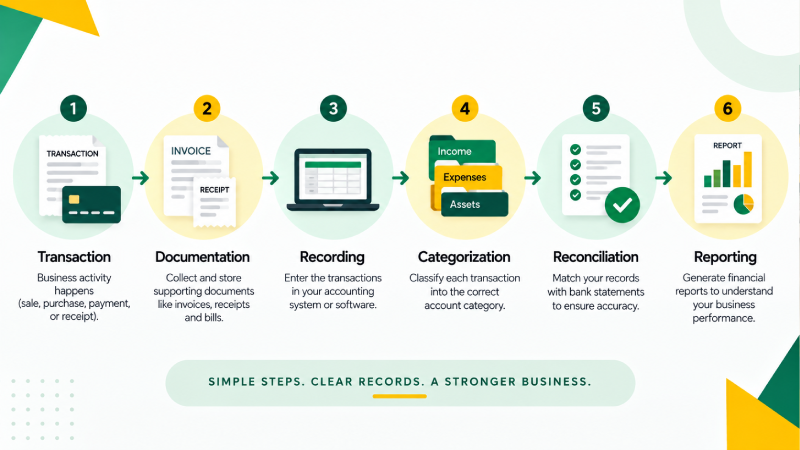
The bookkeeping process can vary depending on the business, but the basic workflow is similar.
Step 1: Identify the Transaction
First, identify a financial transaction.
For example, a customer pays an invoice for $2,500.
Step 2: Collect Supporting Information
The business keeps documentation related to the transaction.
This could include an invoice, receipt, payment confirmation, bank record, or other supporting document.
Step 3: Record the Transaction
The transaction is entered into the bookkeeping system.
The business may use accounting software, a spreadsheet, or another appropriate recordkeeping system.
Step 4: Categorize the Transaction
The transaction is assigned to the appropriate account.
For example, a software subscription may be recorded as a business software expense.
Step 5: Post the Transaction to the Appropriate Accounts
The transaction becomes part of the business financial records and, where applicable, the general ledger.
Step 6: Reconcile Accounts
The business compares its records with external statements such as bank or credit card statements.
Differences should be investigated and corrected.
Step 7: Review the Records
The business reviews its bookkeeping records to identify unusual transactions, missing information, duplicate entries, or classification errors.
Step 8: Prepare Financial Reports
The organized bookkeeping data can then support reports such as an income statement and balance sheet.
The IRS explains that journals can be used to record transactions and ledgers organize transaction totals by account.
Types of Bookkeeping
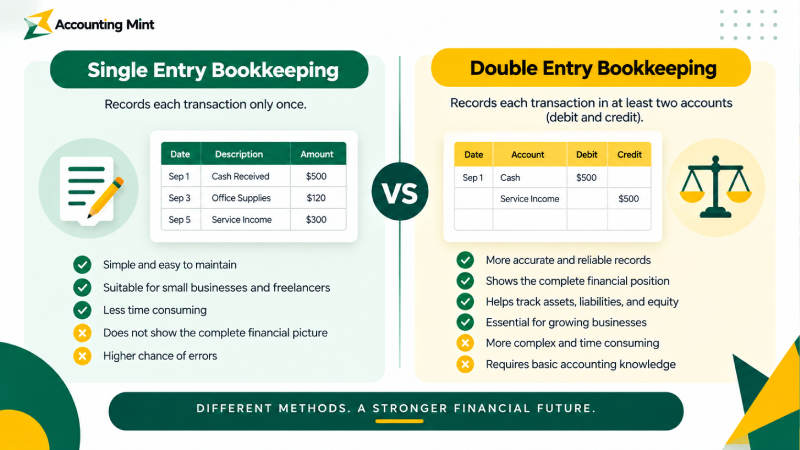
The two main bookkeeping systems are single entry bookkeeping and double entry bookkeeping.
Single Entry Bookkeeping
Single entry bookkeeping records transactions in a simpler format.
It can be compared to maintaining a basic personal financial record where income and expenses are tracked.
For very simple business activities, this approach may appear easier to maintain. However, it provides less detailed financial information than double entry bookkeeping.
Double Entry Bookkeeping
Double entry bookkeeping records each financial transaction using two corresponding accounting entries.
For example, when a business purchases equipment using cash, the equipment account increases while the cash account decreases.
The two sides are recorded so the accounting records remain balanced.
The IRS describes double entry bookkeeping as a system using journals and ledgers where each account has debit and credit sides and total debits and credits must remain equal after transactions are posted.
Single Entry vs Double Entry Bookkeeping
| Feature | Single Entry | Double Entry |
|---|---|---|
| Recording approach | Simpler transaction record | Two sided transaction record |
| Complexity | Lower | Higher |
| Financial detail | More limited | More comprehensive |
| Account structure | Basic | Structured accounts |
| Suitable use | Very simple activities | Businesses with broader financial activity |
| Error checking | More limited | Built in balancing helps identify differences |
Double entry bookkeeping is widely used because it provides a more complete picture of financial transactions and supports structured financial reporting.
Cash Basis and Accrual Basis Bookkeeping
Cash basis and accrual basis describe when financial transactions are recognized in the accounting records.
Cash Basis
Under the cash basis, income is generally recorded when payment is received and expenses are generally recorded when payment is made.
For example, if a business sends an invoice to a customer in March but receives payment in April, the transaction is generally recognized based on the applicable cash basis rules when payment is received.
Accrual Basis
Under the accrual basis, transactions are generally recognized when the underlying economic activity occurs rather than waiting for the cash movement.
For example, a business may provide a service in March and receive payment from the customer in April. Under an accrual approach, the revenue may be recognized in March because that is when the service was provided.
The specific accounting method a business can or should use can depend on its circumstances and applicable tax and accounting rules. Businesses should consult a qualified tax or accounting professional when making decisions about their accounting method.
CFI explains the core difference between cash and accrual methods as the timing of when transactions are recorded in the books.
Bookkeeping Example for a Small Business
Consider a small web design business called Bright Web Studio.
During one month, the business has these transactions:
| Transaction | Amount |
|---|---|
| Client payment received | $5,000 |
| Software expense | $300 |
| Advertising expense | $500 |
| Office supplies | $200 |
| Contractor payment | $1,000 |
The bookkeeping system records each transaction and assigns it to the appropriate account.
The business can then review:
- Total revenue
- Total expenses
- Outstanding invoices
- Outstanding bills
- Bank balance
- Business expenses by category
- Overall financial activity
Suppose the company sends another $2,000 invoice to a client but has not received payment yet.
The bank balance will not include that $2,000 because the money has not arrived.
However, the business still needs to track the invoice and the amount owed by the customer.
This is why bookkeeping provides more information than simply checking a bank account.
Bookkeeping vs Accounting
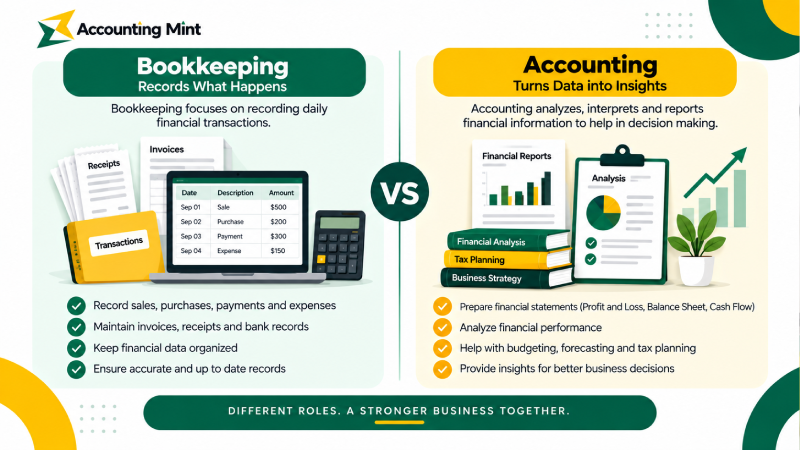
Bookkeeping and accounting are closely connected, but they are not exactly the same.
Bookkeeping primarily focuses on recording and organizing financial transactions.
Accounting uses financial information to prepare reports, analyze results, interpret financial activity, and support business decisions.
| Bookkeeping | Accounting |
|---|---|
| Records financial transactions | Analyzes financial information |
| Organizes financial records | Interprets financial results |
| Categorizes transactions | Prepares and reviews reports |
| Reconciles accounts | Uses reports for analysis |
| Tracks invoices and bills | Supports planning and decision making |
| Provides organized financial data | Turns financial data into useful information |
A simple way to understand the relationship is:
Bookkeeping creates the financial record. Accounting uses that record to understand the business.
For a very small business, the same person may perform both bookkeeping and accounting related activities. As a business grows, these responsibilities may be divided among a bookkeeper, accountant, finance professional, or other staff.
Xero and Forbes both describe bookkeeping as the transaction recording and record maintenance function, while accounting involves interpreting and using that information for reporting and decision making.
Also Read: What Is Accounting? Definition, Basics, and How It Works
What Does a Bookkeeper Do?
A bookkeeper helps maintain accurate and organized financial records.
The exact responsibilities depend on the business.
Common Bookkeeping Responsibilities
A bookkeeper may:
- Record sales
- Record expenses
- Track customer payments
- Track supplier bills
- Reconcile bank accounts
- Reconcile credit card accounts
- Maintain the general ledger
- Organize receipts
- Track accounts receivable
- Track accounts payable
- Assist with payroll records
- Prepare regular financial reports
- Organize documents for tax preparation
Xero groups bookkeeping responsibilities into core duties such as data entry and bank reconciliation, followed by additional activities such as accounts receivable, accounts payable, and payroll.
Some bookkeepers also provide more advanced support such as reporting, budgeting assistance, software setup, and coordination with accountants.
Bookkeeping for Small Businesses
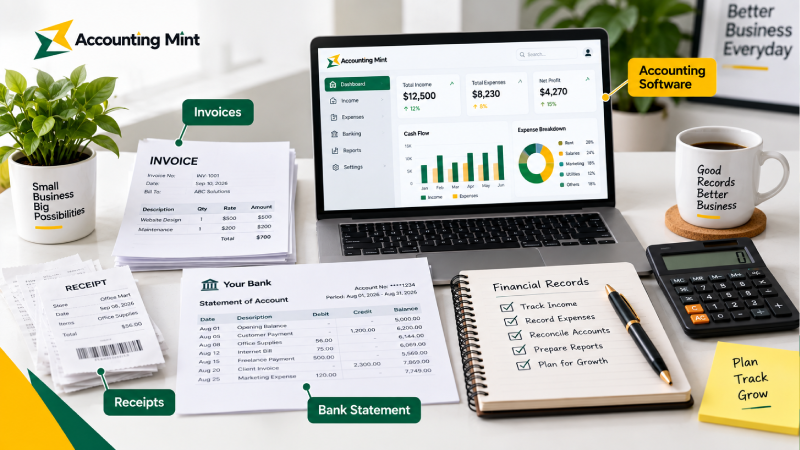
Bookkeeping is especially important for small businesses because owners often make financial decisions directly.
A small business may choose to handle bookkeeping internally, use accounting software, hire a part time bookkeeper, or outsource bookkeeping services.
Do It Yourself Bookkeeping
Some business owners manage their own books when the transaction volume is relatively low and the financial activity is straightforward.
This can reduce professional service costs, but the owner needs to understand basic bookkeeping principles and maintain records consistently.
Use Accounting Software
Accounting software can automate many bookkeeping tasks.
Depending on the software, features may include:
- Bank transaction imports
- Invoicing
- Expense tracking
- Financial reports
- Bank reconciliation
- Receipt management
- Accounts receivable
- Accounts payable
Hire a Bookkeeper
A business may hire a bookkeeper when financial transactions become too numerous or complicated for the owner to manage efficiently.
A professional bookkeeper can help maintain consistent records and identify discrepancies.
Outsource Bookkeeping
A business can also work with an external bookkeeping service.
Virtual bookkeeping allows bookkeeping work to be performed remotely using online accounting systems and digital records. Xero describes virtual bookkeepers as professionals who provide bookkeeping services remotely using online tools.
Bookkeeping Software
Modern bookkeeping is often performed using accounting software rather than physical books.
Bookkeeping software can help businesses record and process transactions, manage invoices, reconcile accounts, and generate financial reports.
Xero describes bookkeeping software as software designed to record and process business transactions and notes that many systems can also support billing, payroll, accounts payable, tax related processes, and financial reporting.
Spreadsheet Bookkeeping
A spreadsheet may work for a very small business with limited transactions.
However, spreadsheets require more manual data entry and can become difficult to maintain as transaction volume increases.
Accounting Software
Accounting software can automate parts of the bookkeeping process and provide a centralized system for financial records.
The appropriate solution depends on the business size, transaction volume, industry, reporting needs, budget, and other requirements.
AccountingMint can later publish dedicated guides comparing accounting software options for different types of businesses.
Common Bookkeeping Mistakes
Even simple bookkeeping systems can become inaccurate when records are not maintained consistently.
Mixing Personal and Business Transactions
Business owners should generally keep business and personal financial activity separate.
The IRS specifically recommends maintaining a separate business checking account rather than combining business and personal transactions.
Not Reconciling Bank Accounts
A bookkeeping system can contain errors even when the bank balance appears correct.
Regular reconciliation helps identify missing, duplicated, or incorrectly recorded transactions.
Forgetting Business Expenses
Missing expense records can make financial reports less accurate and may create problems during tax preparation.
Incorrectly Categorizing Transactions
An expense should be assigned to the appropriate account based on the nature of the transaction.
Delaying Bookkeeping
Waiting several months before updating the books makes it harder to identify errors and understand current financial performance.
Failing to Keep Supporting Documents
Invoices, receipts, statements, and other documents provide evidence supporting financial entries.
The IRS states that supporting documents should be maintained to establish amounts and transactions reported on tax returns.
Records a Business Should Maintain
The specific records a business needs can vary based on its structure, activities, tax situation, and applicable requirements.
Common business records include:
- Sales invoices
- Purchase invoices
- Receipts
- Bank statements
- Credit card statements
- Deposit records
- Canceled checks
- Payroll records
- Loan documents
- Expense records
- Customer payment records
- Supplier payment records
- Asset purchase documents
The IRS states that businesses should keep records and supporting documents that establish income, expenses, deductions, and other information reported on applicable tax returns.
Businesses should review the current IRS requirements applicable to their situation rather than relying on a general record retention period.
Important Bookkeeping Terms
Understanding basic bookkeeping terminology makes financial records easier to understand.
Assets
Assets are resources owned or controlled by a business that have economic value.
Examples can include cash, equipment, inventory, and accounts receivable.
Liabilities
Liabilities are financial obligations owed by a business.
Examples include loans, credit card balances, and accounts payable.
Equity
Equity represents the owner’s financial interest in the business after liabilities are considered.
Revenue
Revenue represents income generated from the business’s normal activities.
Expenses
Expenses are costs incurred while operating the business.
Accounts Receivable
Accounts receivable represents money customers owe the business.
Accounts Payable
Accounts payable represents amounts the business owes to suppliers or other parties.
General Ledger
A general ledger organizes transactions by account and provides an important foundation for financial reporting.
Journal Entry
A journal entry records the accounting details of a financial transaction.
Chart of Accounts
A chart of accounts is an organized list of accounts used by a business to classify its financial transactions.
Future AccountingMint Article: What Is a Chart of Accounts?
How Often Should Bookkeeping Be Done?
The appropriate bookkeeping frequency depends on the size and transaction volume of a business.
A business with only a few transactions may need less frequent bookkeeping than a company processing hundreds of transactions every week.
Common bookkeeping schedules include:
Daily Bookkeeping
Daily bookkeeping can be useful for businesses with high transaction volumes or frequent cash activity.
Weekly Bookkeeping
Weekly bookkeeping helps keep financial records current without requiring daily attention.
Monthly Bookkeeping
Monthly bookkeeping is common for many small businesses and allows the owner to review financial activity regularly.
Regardless of the schedule, businesses should avoid allowing transactions to accumulate for long periods without review.
The IRS notes that recording transactions daily is generally a good practice for maintaining accurate records.
When Should a Small Business Hire a Bookkeeper?
There is no single point at which every business needs a professional bookkeeper.
A business owner may consider professional bookkeeping support when:
- Transaction volume increases
- Reconciliation becomes difficult
- Invoices are not being tracked consistently
- Bills are being missed
- Payroll becomes more complicated
- Financial reports are difficult to understand
- The owner spends too much time maintaining records
- The business operates across multiple accounts
- The business is preparing for financing or significant growth
The goal is not simply to outsource bookkeeping. The goal is to maintain accurate and timely financial information that the business can actually use.
Frequently Asked Questions
What is bookkeeping in simple terms?
Bookkeeping is the process of recording and organizing the financial transactions of a business. It tracks money coming into and going out of the business and maintains the records used for financial reporting and other purposes.
What is the main purpose of bookkeeping?
The main purpose of bookkeeping is to maintain accurate and organized financial records. These records help a business understand income, expenses, cash activity, amounts owed, and overall financial performance.
What are the two main types of bookkeeping?
The two main bookkeeping systems are single entry bookkeeping and double entry bookkeeping. Double entry bookkeeping records each transaction using corresponding debit and credit entries.
Is bookkeeping the same as accounting?
No. Bookkeeping primarily focuses on recording and organizing financial transactions. Accounting uses financial information to prepare reports, analyze results, and support financial decisions.
Can a small business do its own bookkeeping?
Yes. A small business can manage its own bookkeeping when its financial activity is relatively straightforward and the owner has the time and knowledge to maintain accurate records. Businesses can also use accounting software or hire bookkeeping professionals.
What does a bookkeeper do every day?
Daily activities can include recording transactions, categorizing expenses, tracking invoices, recording payments, reconciling accounts, and maintaining financial records. The exact responsibilities depend on the business.
Why is bank reconciliation important in bookkeeping?
Bank reconciliation compares the business bookkeeping records with bank statements. It can help identify missing transactions, duplicate entries, errors, and other differences.
Can bookkeeping help with taxes?
Yes. Organized bookkeeping provides records of business income and expenses that can support tax preparation. Businesses should follow the current requirements that apply to their tax situation.
Is bookkeeping difficult for beginners?
Basic bookkeeping can be learned by understanding financial transactions, account categories, debits and credits, reconciliation, and recordkeeping. More complex businesses may require professional bookkeeping or accounting support.
Sources
- Tally Solutions: Bookkeeping: Definition, Importance, Types and Tasks
- Forbes: What Is Bookkeeping? Everything You Need To Know
- Corporate Finance Institute: What is Bookkeeping?