
If you are starting a business, managing company finances, studying business, or simply trying to understand how financial information works, you may be asking what is accounting and why it is important.
Accounting is the process of recording, organizing, classifying, summarizing, and communicating financial information. It helps a business understand its revenue, expenses, assets, liabilities, equity, cash activity, and overall financial position.
Accounting is much more than entering numbers into accounting software. It provides a structured way to turn individual financial transactions into useful information that can help business owners, managers, lenders, investors, tax professionals, and other users understand a business.
For example, a business may receive payments from customers, pay employees, purchase equipment, pay rent, purchase supplies, receive a business loan, or send invoices to customers. Each of these activities can affect the financial records of the business.
When these transactions are properly recorded and organized, the business can create financial reports and better understand what is happening financially.
For small businesses in the United States, accounting can also play an important role in maintaining records and supporting federal tax reporting. The IRS explains that good business records can help owners monitor business progress, prepare financial statements, identify sources of income, track expenses, and support information reported on tax returns.
Key Highlights
- Accounting organizes financial information so a business can understand and use it.
- Accounting involves recording, classifying, summarizing, reviewing, and reporting financial transactions.
- The basic accounting equation is Assets = Liabilities + Equity.
- Bookkeeping is closely related to accounting, but accounting includes broader reporting and analysis activities.
- Businesses may use cash or accrual methods depending on their circumstances and applicable rules.
- Accounting records can help businesses prepare financial statements and support tax reporting.
- Good accounting practices can give business owners a clearer view of revenue, expenses, assets, liabilities, and business performance.
What Is Accounting?
Accounting is the process of recording, organizing, classifying, summarizing, and communicating financial information.
Every business generates financial transactions. A restaurant receives payments from customers and purchases food and supplies. A consulting company invoices clients and pays employees. An online store receives customer orders, purchases inventory, pays shipping costs, and pays for software.
All of these activities create financial information.
Accounting provides a system for organizing that information.
Instead of looking at hundreds or thousands of individual transactions separately, accounting groups transactions into meaningful categories and accounts.
For example, a business may organize financial information into:
- Sales revenue
- Payroll expenses
- Rent expense
- Advertising expense
- Software expenses
- Cash
- Accounts receivable
- Equipment
- Accounts payable
- Business loans
- Owner equity
Once transactions are organized, they can be summarized into financial reports.
This allows a business owner to move from simply knowing that transactions occurred to understanding what those transactions mean for the business.
What Does Accounting Mean?
In simple terms, accounting means keeping an organized financial record of a business and using that information to understand its financial activity.
The meaning of accounting goes beyond recording money coming into and going out of a bank account.
A business may have revenue that has been earned but has not yet been collected. It may also have expenses that have been incurred but have not yet been paid.
A business may own equipment, have outstanding loans, owe suppliers money, or have customers who have not yet paid their invoices.
Accounting brings these different financial activities into an organized system.
Accounting information can help answer questions such as:
- How much revenue did the business generate?
- What were the business expenses?
- How much cash does the business have?
- How much do customers owe?
- How much does the business owe suppliers?
- What assets does the business have?
- What liabilities does the business have?
- How much equity does the owner have?
- Is the business generating a profit?
- How has the financial position changed over time?
The Financial Accounting Standards Board describes assets, liabilities, and equity as elements that describe resources and claims or interests in resources at a specified date. It also identifies revenues and expenses among the elements describing effects of transactions and other events during reporting periods.
Why Is Accounting Important?
Accounting is important because financial information can help people understand what is happening inside a business.
Without organized financial information, a business owner may have difficulty determining whether the business is actually performing well.
A business can have high sales and still experience financial pressure because of high expenses, unpaid customer invoices, loan obligations, or other financial commitments.
Accounting provides a structured way to understand these different factors.
Understanding Business Performance
Accounting helps organize information about revenue and expenses.
For example, imagine a small marketing agency generates $50,000 in revenue during a month.
At first, $50,000 may appear to be a strong result.
However, the agency may also have $35,000 in payroll, software, rent, advertising, contractor, and other expenses.
Looking at revenue alone does not provide the complete picture.
Accounting allows the business to look at revenue and expenses together and understand the resulting financial performance.
Tracking Income and Expenses
A business needs to know where its money comes from and where it is being spent.
Accounting records can organize income by source and expenses by category.
This can make it easier to identify changes in spending and understand how different costs affect the business.
Preparing Financial Statements
Accounting information is used to prepare financial statements.
Common financial statements include:
| Financial Statement | Main Purpose |
|---|---|
| Balance Sheet | Shows assets, liabilities, and equity at a specific date |
| Income Statement | Shows revenue and expenses for a period |
| Statement of Cash Flows | Shows cash inflows and outflows during a period |
The IRS also notes that good records are needed to prepare accurate financial statements, including income statements and balance sheets.
Supporting Tax Reporting
Businesses need financial records to support information reported for federal tax purposes.
The IRS states that business records should support income, expenses, and other information used on tax returns. Supporting documents can include invoices, receipts, deposit records, paid bills, and other documentation related to business transactions.
Accounting does not replace professional tax advice, but organized accounting records can provide the financial information needed for tax preparation.
Supporting Business Decisions
Accounting information can help business owners evaluate financial decisions.
For example, before hiring another employee, a business owner may review revenue, payroll costs, operating expenses, available cash, and outstanding obligations.
Before purchasing equipment, the owner may review the financial effect of the purchase.
Accounting provides information that can be used as part of these decisions.
Also Read: What Is Bookkeeping? Definition, Types, Process and Examples
How Does Accounting Work?
Accounting begins with financial transactions.
A transaction can be a sale, purchase, payment, receipt, loan, payroll transaction, equipment purchase, or another event that affects the financial records of a business.
The transaction is supported by documentation and then entered into the accounting system.
A simplified accounting process looks like this:
- Identify the financial transaction.
- Collect supporting documentation.
- Record the transaction.
- Classify the transaction.
- Post the transaction to the appropriate accounts.
- Review and reconcile the records.
- Prepare financial reports.
- Review the financial information.
The IRS explains that business transactions are commonly summarized in journals and ledgers. A journal records transactions, while a ledger organizes totals by account. Electronic accounting systems can also be used as long as they provide complete and accurate records.
What Is the Accounting Cycle?
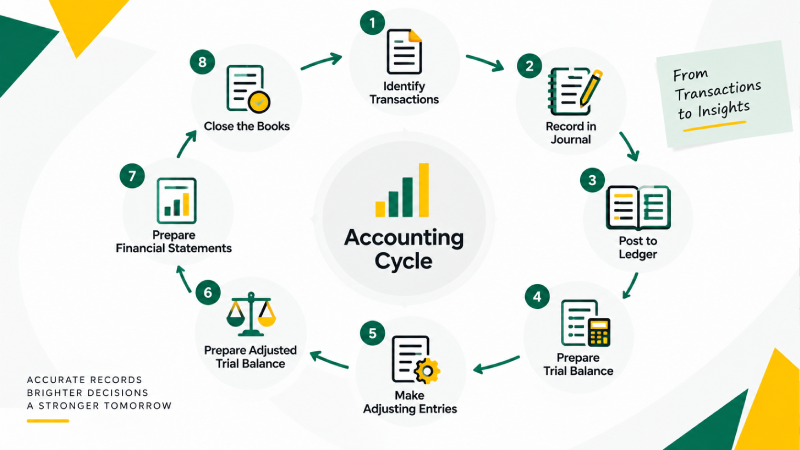
The accounting cycle is the process used to record and organize financial information during an accounting period.
The exact process can vary depending on the accounting system and business, but the basic flow can be understood through several steps.
Step 1: Identify Transactions
The business first identifies financial transactions that need to be recorded.
Examples include:
- Customer sales
- Customer payments
- Supplier purchases
- Rent payments
- Payroll
- Loan payments
- Equipment purchases
- Business subscriptions
Step 2: Collect Source Documents
Source documents provide evidence of financial transactions.
Examples include:
- Invoices
- Receipts
- Sales records
- Bank records
- Deposit records
- Paid bills
- Payroll records
- Loan documents
The IRS identifies supporting documents such as sales slips, paid bills, invoices, receipts, deposit slips, and canceled checks as examples of business records.
Step 3: Record Transactions
The transaction is entered into the accounting system.
A business may use accounting software, spreadsheets, journals, or another recordkeeping system.
The IRS states that transactions should generally be recorded regularly and notes that recording transactions daily is generally a good practice.
Step 4: Classify Transactions
Transactions are assigned to appropriate accounts.
For example, a software subscription may be recorded under a software or operating expense account.
A customer invoice may create an accounts receivable balance.
Equipment purchased for business use may be recorded as an asset depending on the applicable accounting treatment.
Step 5: Post Transactions to Accounts
The recorded transaction information is organized within the appropriate accounts.
This allows the business to see totals for different types of financial activity.
Step 6: Reconcile Accounts
Businesses can compare their accounting records with supporting records such as bank statements.
Reconciliation can help identify missing transactions, duplicate entries, timing differences, or other discrepancies.
Step 7: Prepare Financial Statements
Once financial information has been recorded and reviewed, it can be summarized into financial statements.
These reports provide different views of business activity and financial position.
Step 8: Review Financial Information
The final information can be reviewed to understand business performance, financial position, cash activity, and other relevant financial information.
Basic Accounting Terms
Understanding common accounting terms makes it easier to read financial reports and understand business finances.
Assets
Assets are economic resources associated with a business.
Examples include:
- Cash
- Accounts receivable
- Inventory
- Equipment
- Buildings
- Vehicles
Assets can be current or long term depending on their nature and the applicable accounting framework.
Liabilities
Liabilities represent obligations of a business.
Examples include:
- Accounts payable
- Business loans
- Accrued obligations
- Other amounts owed to creditors
Liabilities represent claims against the resources of a business.
Equity
Equity represents the residual interest in the assets of an entity after liabilities are deducted.
For a business, equity can be affected by owner investments, distributions, revenues, expenses, gains, and losses depending on the business structure and accounting framework.
Revenue
Revenue generally represents amounts earned from activities such as providing services or selling products under the applicable accounting framework.
For example, a consulting company may earn revenue by providing professional services to clients.
Expenses
Expenses represent costs associated with operating a business and generating revenue.
Examples include:
- Payroll
- Rent
- Advertising
- Software
- Insurance
- Utilities
- Professional services
Accounts Receivable
Accounts receivable represents amounts customers owe a business for goods or services provided on credit.
For example, if a business sends a customer a $5,000 invoice and the customer has not paid yet, the amount may be recorded as accounts receivable under the applicable accounting method.
Accounts Payable
Accounts payable represents amounts a business owes suppliers or other parties for goods or services received.
For example, if a supplier provides $2,000 of business supplies and allows the company to pay later, the amount may be recorded as accounts payable.
What Is the Accounting Equation?
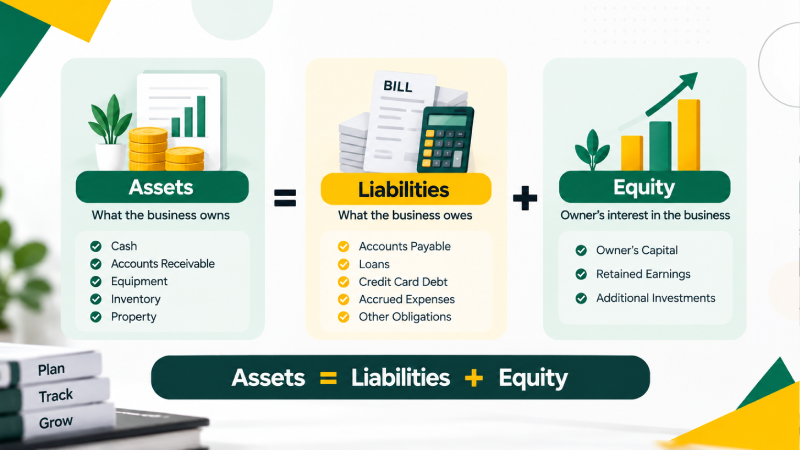
One of the most important concepts in accounting is the basic accounting equation:
Assets = Liabilities + Equity
The equation represents the relationship between the resources of a business and the claims against those resources.
For example, suppose a business has:
- $50,000 in assets
- $20,000 in liabilities
- $30,000 in equity
The equation would be:
$50,000 Assets = $20,000 Liabilities + $30,000 Equity
The three elements can be summarized as follows:
| Element | Simple Meaning | Example |
|---|---|---|
| Assets | Resources associated with the business | Cash and equipment |
| Liabilities | Amounts the business owes | Loan and accounts payable |
| Equity | Residual interest after liabilities | Owner investment and accumulated results |
The FASB conceptual framework explains that equity is the difference between assets and liabilities.
Cash Accounting and Accrual Accounting
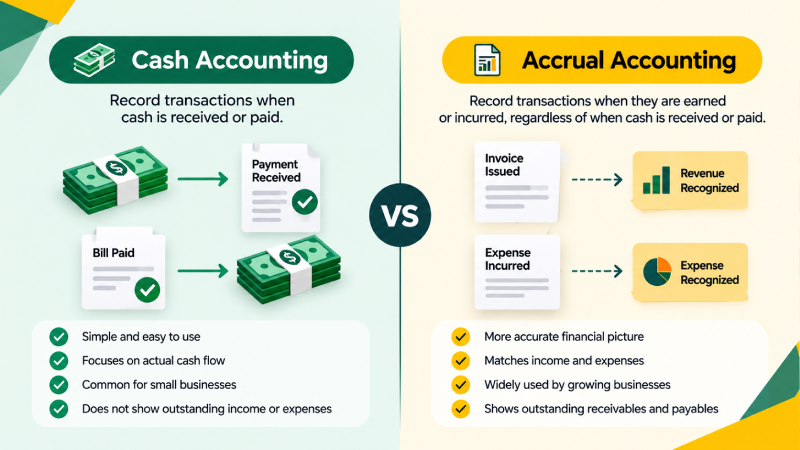
One important area of accounting is the method used to recognize income and expenses.
For federal income tax purposes, businesses may use different accounting methods depending on their circumstances and applicable rules.
Cash Accounting
Under the cash method for federal income tax purposes, income is generally reported when received and expenses are generally deducted or capitalized when paid, subject to applicable rules.
The cash method can be relatively straightforward for some qualifying businesses because it closely follows cash receipts and payments.
Accrual Accounting
Under an accrual method for federal income tax purposes, income is generally reported when earned and expenses are generally deducted or capitalized when incurred, subject to applicable rules.
Accrual accounting can provide a different view of financial activity because the timing of revenue and expenses does not necessarily match the timing of cash movement.
| Feature | Cash Method | Accrual Method |
|---|---|---|
| Income timing | Generally when received | Generally when earned |
| Expense timing | Generally when paid | Generally when incurred |
| Focus | Cash movement | Financial activity and timing |
| Common records | Cash receipts and payments | Receivables, payables, and other accounting records |
The IRS explains that businesses must use an accounting method that clearly reflects income. The IRS also notes that changing an accounting method can generally require approval.
What Are the Main Types of Accounting?
Accounting covers several areas, each with a different purpose.
Financial Accounting
Financial accounting focuses on financial information and reporting for users who need information about an organization’s financial position and performance.
Financial accounting commonly involves financial statements and reporting processes.
Management Accounting
Management accounting provides financial information for internal planning, analysis, budgeting, and business decisions.
Managers may use this information to evaluate costs, budgets, performance, and future plans.
Cost Accounting
Cost accounting focuses on understanding and analyzing costs associated with products, services, activities, or operations.
It can be especially relevant to businesses that need to understand the cost of producing or delivering something.
Tax Accounting
Tax accounting focuses on financial information in relation to applicable tax rules and tax reporting requirements.
Tax accounting can involve federal, state, and local tax considerations depending on the business.
Forensic Accounting
Forensic accounting involves examining financial information in situations such as disputes, investigations, and potential financial misconduct.
Auditing
Auditing involves examining financial information and related evidence according to the requirements of a particular audit or assurance engagement.
Accounting Standards in the United States
Accounting standards provide frameworks and requirements for preparing and reporting financial information.
US GAAP
US GAAP means Generally Accepted Accounting Principles used in the United States.
The Financial Accounting Standards Board establishes financial accounting and reporting standards for public and private companies and not for profit organizations in the United States.
The specific accounting requirements that apply can depend on the type of organization, transaction, reporting purpose, and applicable standards.
IFRS
IFRS means International Financial Reporting Standards.
IFRS is developed by the International Accounting Standards Board and is used in many jurisdictions outside the United States.
For AccountingMint, the primary focus should remain on US accounting, financial, tax, and small business topics unless an article specifically compares US accounting with international requirements.
Practical Accounting Examples
Examples can make accounting concepts easier to understand.
Example 1: Owner Invests Money in a Business
Suppose an owner contributes $20,000 to start a business.
The business receives $20,000 in cash and records the corresponding equity interest.
The simplified equation becomes:
$20,000 Assets = $0 Liabilities + $20,000 Equity
This shows how an owner investment affects the financial position of the business.
Example 2: Business Purchases Equipment
Suppose the business uses $3,000 of cash to purchase equipment.
The business now has less cash but has equipment recorded as an asset, subject to the applicable accounting treatment.
The transaction changes the composition of the assets.
Example 3: Business Makes a Sale
Suppose a consulting company provides services worth $2,000 to a customer.
If the customer pays immediately, the transaction can increase cash.
If the customer will pay later, the transaction may create accounts receivable under an applicable accrual method.
The example demonstrates why accounting involves more than simply tracking money in a bank account.
Accounting for Small Businesses
Small business accounting uses the same basic concepts but may involve fewer transactions and simpler financial structures.
A small business may need to track:
- Sales
- Customer invoices
- Business expenses
- Supplier bills
- Payroll
- Bank transactions
- Loans
- Equipment
- Taxes
- Owner contributions
- Owner distributions
The IRS states that businesses can generally choose a recordkeeping system suited to their business as long as it clearly shows income and expenses, subject to applicable requirements.
Why Small Business Accounting Matters
Good accounting records can help a small business:
- Understand revenue and expenses
- Prepare financial statements
- Monitor business performance
- Track customer balances
- Track amounts owed to suppliers
- Prepare information for tax returns
- Identify unusual transactions
- Understand changes in business costs
- Support financial decisions
The IRS specifically notes that good records can help business owners monitor progress, prepare financial statements, identify income sources, track deductible expenses, prepare tax returns, and support reported tax items.
What Accounting Records Should a Business Keep?
A business should maintain records that support its financial transactions and applicable tax reporting.
Depending on the business, records can include:
- Sales invoices
- Customer receipts
- Supplier invoices
- Paid bills
- Bank statements
- Deposit records
- Payroll records
- Loan documents
- Expense records
- Purchase records
- Accounting journals
- General ledger records
The IRS states that supporting documents are important because they support entries in the business books and information reported on a tax return.
A business should also consider keeping business and personal financial activity separate. IRS guidance recommends opening a business checking account and keeping it separate from a personal checking account.
Accounting Software and Automation
Modern accounting software can make many accounting tasks easier.
Depending on the software, a business may be able to:
- Import bank transactions
- Create invoices
- Track expenses
- Record payments
- Manage accounts receivable
- Manage accounts payable
- Reconcile accounts
- Generate financial reports
- Track business transactions
Accounting software can reduce manual data entry and help organize financial information.
However, software does not eliminate the need for proper accounting processes.
Transactions still need to be reviewed and classified correctly. Businesses also need appropriate documentation and procedures for correcting errors.
The IRS recognizes electronic accounting systems as part of business recordkeeping, provided the system meets applicable recordkeeping requirements and maintains complete and accurate records.
Common Accounting Mistakes
Understanding common mistakes can help business owners build better accounting habits.
Mixing Personal and Business Transactions
Using the same financial accounts for personal and business activity can make accounting records more difficult to organize and review.
Keeping business transactions separate can make it easier to identify business income and expenses.
Recording Transactions Too Late
Waiting too long to record transactions can increase the chance of missing information or forgetting the purpose of a transaction.
Regular recordkeeping makes financial information easier to maintain.
Not Keeping Supporting Documents
A transaction recorded in accounting software should have appropriate supporting documentation when required.
Invoices, receipts, payment records, and other documents can help support accounting entries.
Not Reconciling Accounts
A business may have differences between its accounting records and bank records.
Regular reconciliation can help identify missing transactions, duplicate entries, or other differences.
Using the Wrong Account
A transaction recorded under the wrong account can affect financial reports.
For example, incorrectly classifying an equipment purchase as an ordinary operating expense could affect how financial information is presented.
Relying Only on the Bank Balance
A bank balance does not necessarily represent the complete financial position of a business.
The business may have customer invoices that have not been paid, outstanding supplier bills, loans, equipment, or other financial items.
Accounting vs Bookkeeping
Accounting and bookkeeping are closely related, but they are not exactly the same.
Bookkeeping generally focuses on recording and organizing financial transactions.
Accounting covers broader activities involving financial reporting, analysis, interpretation, and use of financial information.
| Records financial transactions | Uses financial information for broader reporting and analysis |
| Organizes transaction data | Interprets and analyzes financial information |
| Tracks income and expenses | Helps prepare and understand financial reports |
| Maintains financial records | Supports financial decision making |
| Provides accounting data | Uses accounting data for reporting and analysis |
Frequently Asked Questions About Accounting
What is accounting in simple words?
Accounting is the process of recording, organizing, summarizing, and communicating financial information about a business or organization.
What is the main purpose of accounting?
The main purpose of accounting is to create organized financial information that can be used for financial reporting, analysis, recordkeeping, compliance, and business decisions.
What are the basic elements of accounting?
Common fundamental elements include assets, liabilities, equity, revenue, and expenses. The exact definitions and reporting requirements depend on the applicable accounting framework.
What is the accounting equation?
The basic accounting equation is Assets = Liabilities + Equity.
It represents the relationship between a business’s resources and the claims against those resources.
What is the difference between accounting and bookkeeping?
Bookkeeping generally focuses on recording and organizing financial transactions. Accounting includes broader activities such as financial reporting, analysis, interpretation, and use of financial information.
What are the main accounting methods?
Cash and accrual are two commonly discussed accounting methods for federal income tax purposes. Other methods or combinations can apply depending on the circumstances and applicable rules.
Why is accounting important for a small business?
Accounting can help a small business organize financial information, track income and expenses, prepare financial reports, maintain records, and support tax reporting.
Can a small business do its own accounting?
Some small businesses manage routine accounting themselves using accounting software or spreadsheets. The appropriate level of professional assistance depends on the business structure, transaction volume, financial complexity, reporting requirements, and tax situation.
Sources