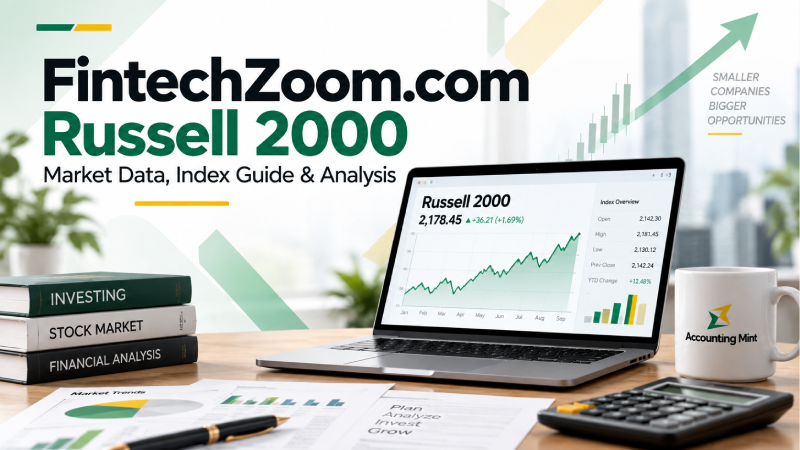
If you are searching for FintechZoom.com Russell 2000, you are likely looking for information about the Russell 2000 Index, small cap market data, performance, analysis, or financial information available through FintechZoom.
The Russell 2000 Index measures the performance of the small cap segment of the US equity market and includes approximately 2,000 of the smallest companies in the Russell 3000 universe. FTSE Russell, part of LSEG, maintains the index and its methodology.
FintechZoom is a separate financial information website. It is important to distinguish the website from the index provider: FintechZoom does not create or maintain the Russell 2000 Index.
This guide explains what the Russell 2000 is, how to research it through financial websites such as FintechZoom, how to interpret market data, what factors affect small cap stocks, how ETFs provide exposure to the index, and where to verify important information.
Key Highlights
- The Russell 2000 measures the performance of approximately 2,000 small cap US companies.
- FTSE Russell maintains the index and its methodology.
- FintechZoom is a third party financial information source, not the official Russell 2000 index provider.
- Russell 2000 performance can be influenced by interest rates, borrowing costs, earnings, inflation, consumer demand, liquidity, and market sentiment.
- Investors cannot purchase the Russell 2000 Index directly.
- ETFs such as IWM and VTWO provide investment products designed to track the index.
- Time sensitive market information should be checked against official index, fund, exchange, and regulatory sources.
FintechZoom.com Russell 2000: Quick Answer
FintechZoom.com Russell 2000 generally refers to using FintechZoom or similar financial information resources to research the Russell 2000 Index.
The Russell 2000 is a US small cap equity benchmark maintained by FTSE Russell. FintechZoom is not the index provider.
If you are looking for current Russell 2000 information, first identify whether you need:
- Current index level
- Historical performance
- Index methodology
- Constituent information
- Small cap market analysis
- ETF information
- Individual stock research
- Market news
For official index information, FTSE Russell is the primary source. Third party financial websites can provide additional context, but important market information should be independently verified.
What Is FintechZoom.com Russell 2000?
The phrase FintechZoom.com Russell 2000 generally describes searches for Russell 2000 information through FintechZoom’s financial content or market research resources.
The Russell 2000 is a small cap stock market index maintained by FTSE Russell. It is a subset of the Russell 3000 and is designed to measure the performance of the small cap segment of the US equity market.
FintechZoom is a separate financial information website.
This distinction is important.
FTSE Russell: Maintains the Russell 2000 methodology and index.
FintechZoom: Provides financial information, market commentary, and investment related content.
Therefore, information found on a third party financial website should not be confused with official index information.
What Is the Russell 2000 Index?
The Russell 2000 is a widely followed benchmark for US small cap stocks.
According to FTSE Russell, the index includes approximately 2,000 of the smallest companies in the Russell 3000 universe and is designed to measure the performance of the US small cap equity segment.
Companies represented in the index operate across many industries, including:
- Healthcare
- Financial services
- Industrials
- Technology
- Consumer products
- Energy
- Real estate
- Other industries
Russell 2000 at a Glance
| Feature | Details |
|---|---|
| Index | Russell 2000 |
| Index provider | FTSE Russell |
| Parent index | Russell 3000 |
| Market focus | US small cap equities |
| Approximate constituents | 2,000 |
| Primary purpose | Measure small cap market performance |
| Common price index code | .RUT |
Index membership can change as companies grow, shrink, merge, or meet different eligibility requirements.
How Does FintechZoom.com Russell 2000 Market Research Work?
Financial websites can make market information easier to access, but readers should understand what type of information is being presented and whether it is current.
When researching the Russell 2000 through FintechZoom or another financial website, consider the following areas.
Russell 2000 Price and Index Movement
The index level represents the value of the benchmark at a particular point in time.
When reviewing a quote, check:
- Date
- Time
- Index symbol
- Data source
- Whether the information is real time
- Whether the information is delayed
- Whether the figure represents a closing value
A daily increase or decrease does not by itself explain why the index moved.
Market movements can be affected by economic releases, interest rate expectations, earnings announcements, inflation data, and investor sentiment.
Historical Market Performance
Historical data can help readers examine how the Russell 2000 behaved over different periods.
For example, investors may compare:
- One month
- Six months
- One year
- Three years
- Five years
- Longer periods
Historical performance can help explain previous market cycles, but past performance does not guarantee future results.
Market News and Economic Developments
Small cap companies can be sensitive to domestic economic conditions.
Important factors can include:
- Interest rates
- Inflation
- Consumer spending
- Lending conditions
- Employment
- Business investment
- Corporate earnings
When reading financial commentary, distinguish between a confirmed economic event and an analyst’s interpretation or forecast.
Individual Small Cap Stocks
The Russell 2000 is an index rather than an individual company.
Its constituents have different:
- Revenue
- Earnings
- Debt levels
- Cash flow
- Valuations
- Business models
- Competitive positions
Therefore, research on an individual company should not rely solely on the overall performance of the Russell 2000.
Also Read: 5StarsStocks.com Review 2026
How to Read Russell 2000 Data on a Financial Website
Understanding financial data is as important as finding it.
| Metric | What It Means |
|---|---|
| Index level | Quoted value of the index |
| Daily change | Change during the trading session |
| Percentage change | Relative gain or loss |
| Historical chart | Movement over a selected period |
| Market capitalization | Market value of a company’s outstanding shares |
| Price to earnings ratio | Valuation measure based on price and earnings |
| Dividend yield | Annual dividends relative to a security’s price |
Not every financial website provides all of these metrics.
When using FintechZoom or another financial website, check the source and timestamp of the information.
Example: Understanding an Index Movement
Suppose the Russell 2000 closes at 2,100 points after ending the previous session at 2,070.
The index increased by:
2,100 − 2,070 = 30 points
Percentage change:
(30 ÷ 2,070) × 100 = approximately 1.45%
This is an educational example and does not represent a current Russell 2000 quote.
Russell 2000 vs. S&P 500 vs. Nasdaq Composite
The Russell 2000 is different from other major US market benchmarks.
| Index | Primary Focus | What It Measures |
|---|---|---|
| Russell 2000 | Small cap US companies | Small cap equity performance |
| S&P 500 | Large US companies | Large cap US equity performance |
| Nasdaq Composite | Nasdaq listed securities | Performance of Nasdaq listed stocks |
| Russell 1000 | Large cap US companies | Large cap equity performance |
The Russell 2000 emphasizes smaller US companies, while the S&P 500 focuses on large companies.
The Nasdaq Composite uses Nasdaq listing eligibility rather than the same market capitalization segmentation used by the Russell indexes.
This means these indexes can behave differently during different economic and market conditions.
What Factors Influence the Russell 2000?
Several economic and financial factors can influence small cap stocks.
Interest Rates and Borrowing Costs
Smaller companies can be more sensitive to financing costs because some have less access to capital or greater dependence on borrowing.
Higher borrowing costs can affect:
- Interest expense
- Profit margins
- Cash flow
- Business expansion
The effect differs from company to company.
Inflation and Operating Costs
Inflation can increase:
- Wages
- Materials
- Transportation costs
- Rent
- Other operating expenses
Companies with limited pricing power may find it harder to pass higher costs to customers.
Consumer Spending
Many small companies depend heavily on US consumer demand.
Changes in employment, household income, consumer confidence, and spending can influence company revenue and earnings.
Corporate Earnings
The financial performance of companies within the index can influence market valuations.
Important measures include:
- Revenue
- Earnings
- Operating margins
- Debt
- Free cash flow
- Valuation
A rising stock price does not necessarily mean a company’s financial condition has improved.
Market Sentiment
Investor risk appetite can affect small cap valuations.
During periods of greater risk appetite, investors may show more interest in smaller companies. During periods of uncertainty, investors may place greater emphasis on financial strength and liquidity.
These relationships can vary across market cycles.
How to Invest in the Russell 2000
The Russell 2000 is an index, so investors cannot purchase the index directly.
Instead, investors can research investment products designed to track the index.
Two examples are:
- iShares Russell 2000 ETF (IWM)
- Vanguard Russell 2000 ETF (VTWO)
IWM seeks to track the Russell 2000 Index and provides exposure to US small cap stocks.
VTWO also seeks to track the Russell 2000 Index and uses a passively managed approach.
These are separate investment products with their own:
- Fees
- Holdings
- Trading prices
- Fund structures
- Tracking characteristics
- Risks
Before researching an ETF, check its current official fund page and prospectus.
Russell 2000 Risks Investors Should Understand
Small cap exposure involves several potential risks.
Higher Price Volatility
Smaller companies can experience significant price movements due to changing earnings expectations, liquidity, and investor sentiment.
Financial and Debt Risk
Some small cap businesses may have limited cash reserves or greater dependence on external financing.
Liquidity Risk
Some small cap securities trade less frequently than large cap stocks. Lower liquidity can contribute to wider bid ask spreads and greater price impact.
Economic Sensitivity
Companies dependent on domestic demand may be affected by changes in employment, consumer spending, credit conditions, and economic growth.
ETF Tracking Differences
An ETF designed to track the Russell 2000 may not produce exactly the same return as the index.
Expenses, portfolio adjustments, cash holdings, and market conditions can contribute to differences.
FintechZoom.com Russell 2000 vs. Official Market Data Sources
One of the most important parts of researching a financial index is understanding which source should be used for which type of information.
| Research Need | Source to Check |
|---|---|
| Russell 2000 methodology | FTSE Russell |
| Index factsheets | FTSE Russell / LSEG |
| ETF holdings and fees | iShares or Vanguard |
| Public company filings | SEC |
| Exchange information | Relevant exchange or authorized provider |
| General market commentary | FintechZoom and other financial publishers |
For example, if a third party website reports a change to Russell 2000 constituents, readers can verify the information through FTSE Russell.
If an article makes a claim about a public company’s earnings or financial condition, SEC filings and company investor relations materials can provide primary-source information.
This cross checking is particularly important when information is time sensitive.
Does FintechZoom Provide Real Time Russell 2000 Data?
Data availability and timing should be confirmed directly on the platform.
A financial website may display:
- Real time information
- Delayed information
- End of day information
- Historical information
When comparing market data, always check the timestamp and source.
Do not assume that a number displayed on a third party financial website is real time unless the platform clearly identifies it as such.
Is FintechZoom.com Russell 2000 Useful for Beginners?
FintechZoom may be useful as an additional financial research resource for readers learning about markets and small cap investing.
However, beginners should first understand the difference between:
Index: A benchmark measuring a group of securities.
Stock: An ownership interest in an individual company.
ETF: An investment fund traded on an exchange that may hold securities designed to track an index.
These instruments have different structures, costs, risks, and characteristics.
Beginners should also avoid treating a single chart, headline, or market opinion as a complete investment analysis.
How to Research the Russell 2000 More Effectively
A structured process can make financial research more reliable.
Step 1: Identify the Exact Index or Product
Determine whether you are researching the Russell 2000 Index, IWM, VTWO, or an individual company.
Step 2: Check the Data Timestamp
Find out whether the quoted value is real time, delayed, or historical.
Step 3: Check the Source
Use FTSE Russell for official index information and fund providers for ETF information.
Step 4: Compare Multiple Time Periods
Look at short and longer periods rather than relying on one day’s movement.
Step 5: Compare Relevant Benchmarks
Compare the Russell 2000 with benchmarks such as the S&P 500 or Russell 1000 when appropriate.
Step 6: Research the Economic Background
Look at interest rates, inflation, earnings, employment, consumer spending, and other factors relevant to small cap businesses.
Step 7: Verify Important Claims
Use official index documents, company filings, ETF prospectuses, and other primary sources when verifying important information.
Step 8: Consider Risk
Understand volatility, liquidity, debt exposure, valuation, and the risks associated with the specific investment product.
Frequently Asked Questions
What is FintechZoom.com Russell 2000?
FintechZoom.com Russell 2000 refers to researching the Russell 2000 small cap stock market index through FintechZoom’s financial information and market related content.
What does the Russell 2000 Index measure?
The Russell 2000 measures the performance of approximately 2,000 small cap US companies within the Russell 3000 universe.
Is FintechZoom the official Russell 2000 index provider?
No. FTSE Russell, part of LSEG, maintains the Russell 2000 Index and its methodology.
Can I buy the Russell 2000 directly?
No. The Russell 2000 is an index rather than a directly purchasable security. Investors can research ETFs and other products designed to provide exposure to the index.
What is the Russell 2000 ticker symbol?
The Russell 2000 is commonly identified by the Reuters price index code .RUT. Ticker conventions can differ between data platforms and financial products.
What is the difference between Russell 2000 and S&P 500?
The Russell 2000 focuses on the small cap segment of the US equity market, while the S&P 500 is primarily a large cap benchmark.
Does FintechZoom provide real time Russell 2000 data?
Data availability and timing should be confirmed directly on the platform. Check whether a displayed quote is real time, delayed, or based on closing prices.
What ETFs track the Russell 2000?
IWM and VTWO are examples of ETFs designed to track the Russell 2000 Index. Investors should review the current official fund documentation for fees, holdings, objectives, and risks.
Why can Russell 2000 stocks be volatile?
Small cap companies can have less diversified revenue, more limited financing access, and lower trading liquidity. These characteristics can contribute to higher price volatility, although actual performance varies by company and market period.
Is FintechZoom enough for investment research?
It should not be treated as the sole source for an investment decision. Important information should be cross checked with official index providers, company filings, fund documents, and other reliable sources.
What factors affect Russell 2000 performance?
Interest rates, borrowing costs, inflation, consumer spending, corporate earnings, liquidity, economic conditions, and market sentiment can influence small cap stock performance.
How often does the Russell 2000 change its constituents?
FTSE Russell maintains the index through scheduled reconstitution and ongoing index maintenance. The exact timing and rules should be checked in the current official Russell US Indexes methodology.
Does the Russell 2000 represent the entire US stock market?
No. The Russell 2000 represents the small cap segment of the US equity market. The Russell 3000 is a broader benchmark covering large, mid, and small cap US companies.
Where can I verify Russell 2000 information?
FTSE Russell and LSEG are primary sources for index information. ETF providers, the SEC, relevant exchanges, and company investor relations pages can also help verify financial information.
Final Thoughts
The FintechZoom.com Russell 2000 search topic connects two different things: a financial information website and a major US small cap market index.
The Russell 2000 itself is maintained by FTSE Russell and is designed to measure the performance of approximately 2,000 small cap companies.
FintechZoom can be considered one source of market information and commentary, but it should not replace official index documentation, ETF fund documents, SEC filings, or other primary sources.
When researching the Russell 2000, pay attention to the data source, timestamp, methodology, market context, investment product, and associated risks.
This approach provides a clearer way to use online financial information while keeping important investment research connected to authoritative sources.
Disclaimer: This article is for educational and informational purposes only. It does not constitute investment, tax, or financial advice. Market data, website features, index composition, and fund information can change. Verify current information through authoritative sources before making financial decisions.