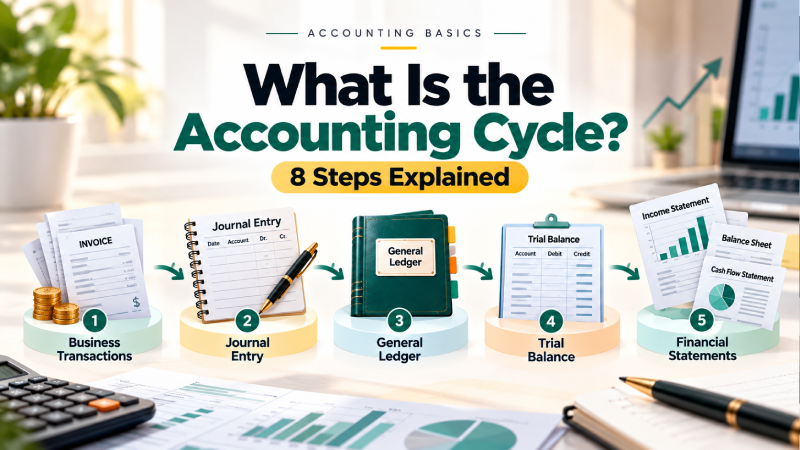
The accounting cycle is the process businesses use to identify, record, organize, adjust, and report financial transactions during an accounting period.
Understanding what accounting is can also help explain how the accounting cycle turns individual transactions into useful financial information.
For a small business, the accounting cycle turns everyday activities such as sales, purchases, payroll, loan payments, and operating expenses into organized accounting records and financial statements.
The process generally includes eight major steps, although businesses may adapt the workflow depending on their accounting system and reporting practices.
Key Takeaways
- The accounting cycle organizes financial transactions from the time they occur through financial reporting.
- The process generally includes eight major steps.
- Journal entries, the general ledger, and trial balance are important parts of the process.
- Adjusting entries help update accounts before financial statements are prepared.
- The cycle generally ends by closing temporary accounts.
- Accounting software can automate many accounting tasks, but businesses still need appropriate review and reconciliation.
What Is the Accounting Cycle?
The accounting cycle is a repeatable process that begins when a business transaction occurs and continues through recording, organizing, adjusting, reporting, and closing the accounting records for a period.
A typical accounting cycle includes:
- Identifying transactions
- Recording transactions
- Posting transactions to the general ledger
- Preparing an unadjusted trial balance
- Recording adjusting entries
- Preparing an adjusted trial balance
- Preparing financial statements
- Closing the books
The exact process can vary between businesses and accounting systems, but the basic purpose remains the same: turn financial transactions into organized and useful financial information.
Why Is the Accounting Cycle Important?
A structured accounting cycle helps businesses keep financial records organized and provides opportunities to review transactions before financial reports are finalized.
For example, if a business records a customer payment incorrectly, the mistake could affect cash, accounts receivable, revenue records, and financial reporting.
Following a defined accounting process can make it easier to:
- Organize financial transactions
- Identify accounting errors
- Reconcile account balances
- Prepare financial statements
- Monitor business performance
- Maintain consistent financial records
For small businesses, maintaining a regular accounting process can also make it easier to work with a bookkeeper, accountant, or tax professional.
The 8 Steps of the Accounting Cycle
1. Identify and Analyze Transactions
This transaction-recording process is closely connected to bookkeeping, which focuses on recording and organizing a business’s financial transactions.
Examples include:
- Customer sales
- Customer payments
- Business purchases
- Rent payments
- Payroll
- Loan payments
- Equipment purchases
- Utility expenses
- Interest payments
The business determines which accounts are affected and how the transaction changes the financial records.
For example, if a business purchases $1,000 of equipment with cash, the transaction affects both the equipment and cash accounts.
2. Record Transactions in the Journal
After analyzing a transaction, it is recorded through a journal entry.
Businesses may use different accounting methods, including cash and accrual accounting, depending on their accounting practices and reporting requirements.
In double entry accounting, transactions generally affect at least two accounts, with total debits equal to total credits.
For example, a business purchases $1,000 of equipment using cash:
| Account | Debit | Credit |
|---|---|---|
| Equipment | $1,000 | — |
| Cash | — | $1,000 |
The journal provides a chronological record of accounting transactions.
This step is closely connected to bookkeeping because accurate transaction recording is the foundation of the accounting process.
3. Post Entries to the General Ledger
After transactions are recorded in the journal, they are posted to the general ledger.
The general ledger organizes transactions according to individual accounts.
For example:
- Cash transactions are recorded in the Cash account.
- Equipment transactions are recorded in the Equipment account.
- Revenue transactions are recorded in the appropriate Revenue account.
The resulting account balances are used later when preparing the trial balance and financial statements.
4. Prepare an Unadjusted Trial Balance
After transactions have been posted to the general ledger, the business can prepare an unadjusted trial balance.
A trial balance lists the account balances and separates debit and credit amounts.
One important check is:
Total Debits = Total Credits
However, a balanced trial balance does not necessarily mean every accounting record is correct.
For example, a transaction could be posted to the wrong account while still keeping total debits and credits equal.
5. Record Adjusting Entries
Adjusting entries are recorded when certain account balances need to be updated before financial statements are prepared.
Examples can include:
- Accrued expenses
- Accrued revenue
- Prepaid expenses
- Depreciation
- Unearned revenue
For example, if a business has incurred an expense but has not yet recorded it, an adjusting entry may be needed to recognize the expense in the appropriate accounting period.
The purpose is to make the accounting records more accurately reflect the period being reported.
6. Prepare the Adjusted Trial Balance
After adjusting entries have been recorded and posted, the business prepares an adjusted trial balance.
This provides an updated list of account balances after the necessary adjustments.
The adjusted balances can then be used to prepare financial statements.
7. Prepare Financial Statements
The next step is preparing financial statements from the adjusted accounting records.
Depending on the business and reporting requirements, financial statements may include:
- Income statement
- Balance sheet
- Statement of cash flows
- Statement of changes in equity
Income Statement
The income statement reports revenues and expenses over a specific period.
Balance Sheet
The balance sheet reports assets, liabilities, and equity at a specific point in time.
Statement of Cash Flows
The statement of cash flows provides information about cash inflows and outflows during a reporting period.
These reports help business owners and other users understand the company’s financial performance and financial position.
8. Close the Books
The final step is closing the books for the accounting period.
Closing entries generally transfer balances from temporary accounts, such as revenue and expense accounts, to the appropriate equity account.
After the closing process, the business can begin the next accounting period with the appropriate opening balances.
The exact closing process depends on the accounting system and business structure.
Accounting Cycle Example for a Small Business
Consider a small consulting business with the following transactions.
Transaction 1: Owner Invests $20,000
The business receives $20,000 from the owner.
| Account | Debit | Credit |
|---|---|---|
| Cash | $20,000 | — |
| Owner’s Equity | — | $20,000 |
Transaction 2: Business Earns $5,000
The business receives $5,000 from customers for services.
| Account | Debit | Credit |
|---|---|---|
| Cash | $5,000 | — |
| Service Revenue | — | $5,000 |
Transaction 3: Business Pays $1,200 in Rent
| Account | Debit | Credit |
|---|---|---|
| Rent Expense | $1,200 | — |
| Cash | — | $1,200 |
These transactions are recorded in the journal and posted to the appropriate general ledger accounts.
At the end of the reporting period, the business reviews the balances, records any necessary adjustments, prepares financial statements, and closes the appropriate temporary accounts.
This shows how individual transactions move through the accounting cycle and eventually become financial information.
Accounting Cycle vs. Bookkeeping
Bookkeeping and the accounting cycle are closely related, but they are not exactly the same.
Bookkeeping primarily involves recording, organizing, and maintaining financial transactions.
The accounting cycle describes the broader process that takes those records through adjustments, financial reporting, and closing.
In simple terms:
Bookkeeping records and organizes transactions, while the accounting cycle takes those records through the complete accounting process.
Understanding both concepts is useful for small-business owners who want to maintain organized financial records.
How Accounting Software Helps With the Accounting Cycle
Modern accounting software can automate many parts of the accounting process.
Depending on the software and configuration, it may help with:
- Recording transactions
- Categorizing transactions
- Maintaining the general ledger
- Creating trial balances
- Bank reconciliation
- Generating financial statements
- Recurring transactions
- Managing invoices
- Tracking expenses
Automation can reduce manual work, but accounting software does not automatically guarantee accurate financial records.
Businesses still need appropriate account setup, transaction review, reconciliation, and financial controls.
Common Accounting Cycle Mistakes
Skipping Transaction Review
Transactions should be reviewed before they become part of financial reporting.
Using Incorrect Accounts
Posting a transaction to the wrong account can distort financial reports even when total debits and credits remain equal.
Forgetting Adjusting Entries
Certain transactions may require adjustments before financial statements are prepared.
Not Reconciling Accounts
Bank and other account reconciliations can help identify differences between accounting records and external records.
Assuming a Balanced Trial Balance Means Everything Is Correct
A balanced trial balance means total debits and credits agree.
It does not prove that every transaction was recorded or classified correctly.
How Often Should a Business Complete the Accounting Cycle?
Businesses organize their accounting activities around reporting periods such as monthly, quarterly, or annually.
The appropriate frequency depends on:
- Transaction volume
- Business size
- Reporting requirements
- Internal processes
- Financial management needs
Many small businesses benefit from reviewing their accounting records regularly instead of waiting until the end of the year.
Regular reviews can make it easier to identify errors and maintain current financial information.
Accounting Cycle Checklist
Use this simplified checklist to understand the typical sequence:
- Identify transactions
- Analyze transactions
- Record journal entries
- Post transactions to the general ledger
- Prepare an unadjusted trial balance
- Record adjusting entries
- Prepare an adjusted trial balance
- Prepare financial statements
- Close temporary accounts
- Begin the next accounting period
Different accounting textbooks and software systems may combine or separate certain steps, which is why you may see different versions of the accounting cycle.
The underlying process remains similar: record transactions, organize account information, make necessary adjustments, prepare reports, and close the period.
Frequently Asked Questions
What is the accounting cycle?
The accounting cycle is the process businesses use to record, organize, adjust, report, and close financial transactions during an accounting period.
What are the 8 steps of the accounting cycle?
The commonly described eight steps are identifying transactions, recording journal entries, posting to the general ledger, preparing an unadjusted trial balance, recording adjustments, preparing an adjusted trial balance, preparing financial statements, and closing the books.
Is bookkeeping part of the accounting cycle?
Yes. Recording and organizing transactions are important parts of the accounting cycle. The process also includes adjustments, financial reporting, and closing activities.
What comes after the general ledger?
A trial balance is typically prepared after account balances have been posted to the general ledger. The process then continues through adjustments and financial reporting.
Can accounting software perform the accounting cycle?
Accounting software can automate many accounting-cycle activities, but businesses still need appropriate configuration, review, reconciliation, and oversight.
Does a balanced trial balance mean the books are completely accurate?
No. A balanced trial balance means the debit and credit totals agree. It does not prove that every transaction was recorded or classified correctly.
Final Thoughts
The accounting cycle provides a structured way to move from individual business transactions to organized financial statements.
Understanding the process helps small-business owners see how journal entries, ledgers, trial balances, adjustments, and financial statements work together.
Accounting software can automate many tasks, but understanding the underlying accounting cycle remains important for reviewing financial information and maintaining reliable business records.