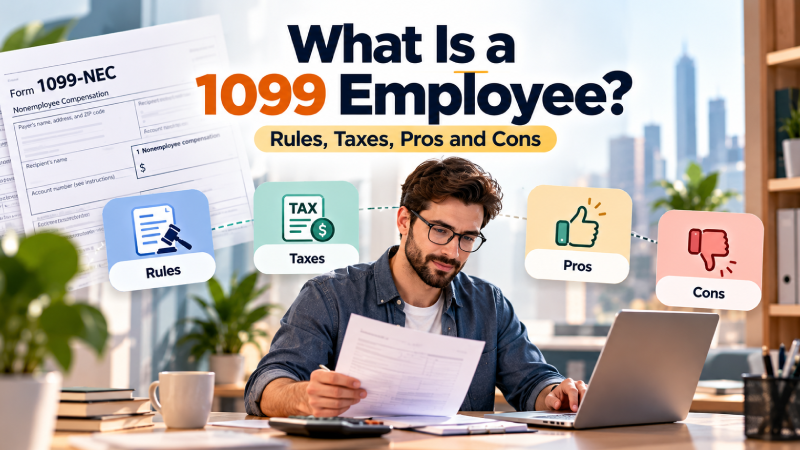
A flexible work arrangement can give professionals more control over their schedules, clients, and income. However, working independently also means taking responsibility for taxes, business expenses, invoices, and financial records.
This is where the term 1099 employee often comes into the conversation. It is commonly used to describe an independent contractor who provides services to a business rather than working as a traditional employee on its payroll.
The term comes from IRS information returns, particularly Form 1099-NEC, which businesses use to report certain payments for services provided by nonemployees. Unlike a typical W-2 employee, an independent contractor generally does not have federal income tax, Social Security, and Medicare taxes withheld from every payment.
Understanding this arrangement is important before accepting a contract, setting your rates, or preparing a tax return.
In this guide, you will learn what a 1099 employee means, how independent contractors differ from W-2 employees, the advantages and disadvantages of contract work, the taxes involved, and the steps to prepare for tax season.
Key Highlights
- A 1099 employee is an informal term for an independent contractor or another type of nonemployee service provider.
- Form 1099-NEC reports qualifying nonemployee compensation paid by a business.
- Independent contractors generally manage their own tax payments and business expenses.
- Self-employed contractors may owe federal income tax and self-employment tax.
- Eligible business expenses may reduce taxable business profit when properly documented.
- Worker classification depends on the actual working relationship, not simply the contract wording or tax form.
- Contractors should keep accurate income records, invoices, receipts, and tax documents throughout the year.
What Is a 1099 Employee?
A 1099 employee is a commonly used but technically imprecise term for an independent contractor who performs services for a business without being treated as its employee for tax purposes.
For example, a company may hire a freelance web designer to build a website, a consultant to improve its operations, or a photographer to cover a corporate event. The professional completes the agreed work and receives payment under the terms of the contract.
If the payment meets the applicable reporting requirements, the business may report it on Form 1099-NEC, or Nonemployee Compensation.
Unlike a regular employee, an independent contractor generally operates with greater control over how the work is performed and is responsible for handling their own business finances and tax obligations.
However, receiving a Form 1099 does not automatically prove that someone is legally an independent contractor. The actual relationship between the worker and the business determines the appropriate classification.
For example, a company may hire a freelance web designer to build a website, a consultant to improve its operations, or a photographer to cover a corporate event. The professional completes the agreed work and receives payment under the terms of the contract.
If the payment meets the applicable reporting requirements, the business may report it on Form 1099-NEC, or Nonemployee Compensation.
Unlike a regular employee, an independent contractor generally operates with greater control over how the work is performed and is responsible for handling their own business finances and tax obligations.
However, receiving a Form 1099 does not automatically prove that someone is legally an independent contractor. The actual relationship between the worker and the business determines the appropriate classification.
What Is Form 1099-NEC?
Form 1099-NEC is an IRS information return used by businesses to report qualifying payments for services made to nonemployees.
The form typically identifies the payer, the recipient, and the amount of reportable compensation. The business sends the required information to the IRS and provides a copy to the recipient.
For payments made in the course of a business, the federal reporting threshold for nonemployee compensation generally changed from $600 to $2,000 for payments made after December 31, 2025. Different rules can apply to certain payments, and reporting requirements should be checked against the instructions for the relevant tax year.
An important distinction is that the reporting threshold does not determine whether income is taxable. A contractor may still need to report income even when no Form 1099-NEC is received.
For current instructions, consult the IRS guide to Form 1099-NEC.
2. How Does a 1099 Employee Work?
An independent contractor generally works under an agreement that describes the services to be delivered, payment terms, deadlines, and other responsibilities.
Instead of receiving wages through a conventional employee payroll system, the contractor may invoice the business for completed work, bill by the hour, charge a project fee, or receive payment according to a service agreement.
Consider a freelance accountant hired by a small business to organize its financial records. The accountant agrees to complete the work for $2,500 and sends an invoice after delivering the service.
The business pays the agreed amount. If the payment meets the applicable information-reporting requirements, the business may need to issue Form 1099-NEC.
The accountant then records the payment as business income, tracks eligible expenses, and determines the taxes owed.
A Simple Example
Suppose a freelance graphic designer earns $60,000 from clients during the year and has $8,000 in eligible business expenses.
| Financial item | Amount |
|---|---|
| Total business income | $60,000 |
| Eligible business expenses | $8,000 |
| Business profit before other applicable adjustments | $52,000 |
The designer generally calculates business profit using the applicable tax rules and reports the relevant amounts on the tax return. This example does not calculate federal income tax, self-employment tax, or any state tax liability.
The main lesson is that gross payments and business profit are not the same thing. Contractors should track both income and expenses rather than treating every payment received as money available to spend.
For a broader understanding of financial records, read AccountingMint’s guide to what is accounting.
3. 1099 Employee vs. W-2 Employee
The main difference between an independent contractor and a W-2 employee is the nature of the working relationship, including the degree of control, financial responsibility, and employment arrangements.
A W-2 employee generally works within the employer’s employment structure. An independent contractor usually provides services through a separate business or independent working arrangement.
| Feature | Independent contractor (often called a 1099 employee) | W-2 employee |
|---|---|---|
| Employment status | Generally self-employed or a nonemployee service provider | Employee |
| Tax document | May receive Form 1099-NEC | Receives Form W-2 |
| Tax withholding | Generally responsible for managing own tax payments | Employer generally withholds applicable payroll taxes |
| Work control | Usually has greater control over how contracted work is completed | Employer generally has greater control over work conditions |
| Benefits | Employee benefits are not automatically provided | May qualify for employer-provided benefits |
| Business expenses | May deduct eligible ordinary and necessary business expenses | Employee business expense deductions are generally restricted under federal rules |
| Payment structure | May bill by project, hour, milestone, or contract | Commonly paid wages or salary through payroll |
| Financial responsibility | Usually handles business records and tax planning | Employer handles payroll reporting and withholding |
Which Arrangement Is Better?
Neither arrangement is automatically better for every worker.
A contract role may suit someone who wants flexibility, works with multiple clients, and can manage variable income. A W-2 role may be preferable to someone who values predictable pay, employer-managed payroll, and access to employment benefits.
The decision should consider total compensation rather than the advertised payment alone. A contractor charging a higher hourly rate may still need to cover health insurance, retirement savings, unpaid leave, equipment, and administrative expenses.
Most importantly, a business cannot make someone an independent contractor simply by issuing Form 1099 or asking the person to sign a contract.
The IRS considers behavioral control, financial control, and the overall relationship between the parties when evaluating worker status. See the IRS guidance on independent contractors and employees.
4. Types of Workers Who May Receive Form 1099-NEC
Many professionals provide services to businesses without becoming their employees. Depending on the circumstances and applicable reporting rules, these professionals may receive Form 1099-NEC.
Examples include:
Freelancers
Freelance writers, designers, developers, editors, and other specialists often work with several clients. They may charge a project fee or invoice for their time.
Independent Consultants
Business, management, technology, and financial consultants may provide advice or specialized services under consulting agreements.
Skilled Contractors
Certain tradespeople and service providers may work independently on specific projects. Their classification depends on the actual working arrangement and applicable law.
Creative Professionals
Photographers, videographers, illustrators, and other creative professionals may receive payments for commissioned work.
Gig and Platform Workers
Some people earn income through delivery services, online marketplaces, and other platforms. The reporting document they receive depends on the platform, the type of income, and the applicable reporting rules.
Not every independent worker will receive Form 1099-NEC. Some payments may be reported on another form, and some income may not generate an information return. Taxpayers are still responsible for determining how to report their income correctly.
5. Advantages of Being a 1099 Contractor
Independent contracting offers several potential benefits, particularly for people who prefer working independently.
Greater Control Over Work
Contractors often have more flexibility in choosing projects, negotiating fees, organizing their schedules, and deciding how to deliver services.
The amount of freedom depends on the contract and the actual working relationship.
Opportunity to Work With Multiple Clients
A contractor can often serve several clients rather than relying on one employer for all income. This can create opportunities to develop different skills, expand a professional network, and build recurring business relationships.
However, having several clients does not eliminate the risk of losing income if demand falls.
Ability to Set Rates
Independent contractors can negotiate project fees, hourly rates, retainers, or other payment structures.
Pricing should account for more than the time spent performing the service. Contractors also need to consider business expenses, taxes, unpaid administrative work, insurance, and periods without billable projects.
Potential Business Expense Deductions
Eligible ordinary and necessary expenses connected to a qualifying business may reduce taxable business profit.
Examples can include certain software subscriptions, business insurance, professional fees, supplies, and qualifying business travel. Expenses must meet the relevant tax requirements and should be supported by records.
Opportunity to Build a Business
Independent contracting can develop into a larger business with recurring customers, standardized services, and additional workers. That possibility can be attractive to professionals who want to move beyond selling their own time.
However, building a sustainable business requires client acquisition, pricing discipline, recordkeeping, and cash flow management.
6. Disadvantages of Being a 1099 Contractor
Flexibility comes with financial and administrative responsibilities that a traditional employee may not handle personally.
Unpredictable Income
Contract work may fluctuate from month to month. A client can reduce its workload, delay a project, or end a contract.
Contractors should consider maintaining an emergency reserve and avoiding fixed personal expenses that depend on consistently high monthly earnings.
No Automatic Employee Benefits
Independent contractors do not automatically receive employee benefits such as employer-sponsored health insurance, paid vacation, or employer retirement contributions.
They may need to arrange insurance, retirement savings, and time off independently.
Responsibility for Taxes
Businesses generally do not withhold federal income tax or Social Security and Medicare taxes from independent contractor payments in the same way they do for employee wages.
Contractors must understand their filing obligations, estimate their tax liability, and make payments when required.
Additional Administrative Work
Invoices, contracts, payment tracking, expense categorization, and tax preparation can take time away from paid work.
Keeping organized records throughout the year is usually easier than reconstructing transactions when a tax deadline approaches.
Potential Client Concentration
A contractor who depends on one major client may face significant financial pressure if that relationship ends.
Building a broader client base can help, although it may not always be practical during the early stages of a business.
7. What Taxes Does a 1099 Contractor Pay?
The tax obligations of an independent contractor depend on the type of income, business structure, deductions, total earnings, and applicable federal and state rules.
For many self-employed individuals in the United States, the main considerations are federal income tax, self-employment tax, and estimated tax payments.
Federal Income Tax
Business profit generally forms part of the taxpayer’s income for federal income tax purposes. The amount owed depends on the individual’s total taxable income, filing status, applicable deductions, credits, and tax brackets.
Receiving a payment without tax withholding does not mean the payment is tax-free.
Self-Employment Tax
Self-employment tax generally covers Social Security and Medicare taxes for people who qualify as self-employed.
For many self-employed individuals, the filing requirement for self-employment tax applies when net earnings from self-employment reach $400 or more, subject to applicable rules and exceptions.
Self-employment tax is calculated separately from regular federal income tax. It should not be confused with the total amount of tax a contractor owes.
Estimated Quarterly Tax Payments
Because taxes are not generally withheld from contractor payments, a contractor may need to pay estimated taxes during the year.
Estimated payments can cover both income tax and self-employment tax. Whether payments are required, how much to pay, and when to pay depend on the taxpayer’s circumstances.
Keeping a portion of each payment aside can help prevent a large unexpected bill at filing time. The appropriate amount varies, so contractors should estimate their liability instead of relying on a universal percentage.
See the IRS estimated tax guidance.
State and Local Taxes
Depending on where the contractor lives and operates, additional state or local income taxes, business taxes, registration requirements, or other obligations may apply.
Contractors should check the rules for their jurisdiction rather than assuming federal compliance covers every requirement.
8. How to File Taxes as a 1099 Contractor
Tax filing becomes more manageable when income and expenses are recorded throughout the year. The following steps provide a general overview for an individual operating a qualifying sole proprietorship or similar self-employed activity.
Step 1: Gather Your Income Records
Collect Form 1099-NEC forms and any other relevant income statements received from clients or platforms.
Compare those forms with your own records, including invoices, bank deposits, payment processor statements, and cash receipts.
Do not assume that only amounts appearing on information returns need to be reported. Income may still be reportable even if you did not receive a tax form.
Step 2: Calculate Total Business Revenue
Add up the income earned from all relevant business activities during the tax year.
Check for duplicate entries, refunds, adjustments, and payments that belong to a different tax period. Use consistent records to reconcile your revenue with the amounts reported by clients.
Step 3: Organize Eligible Business Expenses
Review business expenses and identify those that qualify for deductions under applicable rules.
Potential examples include qualifying software, business supplies, professional services, business insurance, and certain travel expenses. Mixed personal and business expenses may require allocation.
Keep receipts and records that explain the business purpose of each expense.
Step 4: Calculate Business Profit
For a typical sole proprietor, business profit generally starts with business revenue minus allowable business expenses, with tax-specific adjustments applied where necessary.
For example, a contractor with $75,000 in business revenue and $12,000 in allowable business expenses would have $63,000 in profit before other applicable adjustments.
This figure is not necessarily the same as taxable income or the final amount on which every tax is calculated.
Step 5: Complete the Relevant Tax Forms
Many individual sole proprietors report business income and expenses on Schedule C (Form 1040).
Qualifying taxpayers generally use Schedule SE (Form 1040) to calculate self-employment tax when required.
The exact forms depend on the taxpayer’s legal structure, income sources, filing circumstances, and tax year. Partnerships, corporations, and other entities may follow different filing rules.
Step 6: Calculate and Pay the Tax Due
Calculate federal income tax, self-employment tax where applicable, and any other required amounts.
Account for estimated tax payments already made during the year and any withholding from other income sources.
If estimated payments were required but missed or underpaid, a penalty may apply. Check the current IRS instructions for your circumstances.
Step 7: Review the Return and Keep Supporting Records
Before filing, verify names, taxpayer identification details, income totals, expenses, deductions, and payment records.
Keep supporting documents according to applicable record retention requirements. Organized records can help answer questions about reported income or deductions later.
For more information, visit the IRS self-employed tax guidance.
9. Common Tax Deductions for Independent Contractors
A qualifying business may be able to deduct expenses that are ordinary and necessary for operating that business. The availability and amount of a deduction depend on the relevant tax rules and the facts of the expense.
| Expense category | Example | Important consideration |
|---|---|---|
| Software and tools | Design applications, accounting software, project management tools | The expense should have a qualifying business purpose |
| Office supplies | Paper, printing materials, and business stationery | Personal purchases are not automatically deductible |
| Professional services | Tax preparation, bookkeeping, and legal services | The fees must qualify as business expenses |
| Business insurance | Certain professional liability or business policies | Personal insurance and business insurance may be treated differently |
| Home office | Qualifying portion of home expenses | The space and use must meet IRS requirements |
| Business travel | Qualifying transportation and lodging for business | Ordinary commuting is generally not deductible as business travel |
| Business equipment | Computer, monitor, or other work equipment | Deduction timing may depend on depreciation and applicable elections |
| Marketing | Qualifying advertising, website, and promotional costs | Maintain records of the expense and its business purpose |
Keep Personal and Business Expenses Separate
One of the simplest ways to improve financial recordkeeping is to separate business transactions from personal spending.
A dedicated business bank account can make it easier to reconcile revenue, identify expenses, prepare financial reports, and provide documentation when needed.
For a deeper explanation of how financial records are organized, read our guide to the general ledger.
Remember that not every purchase made while working is deductible. A tax professional can help determine whether a specific expense qualifies and how it should be reported.
10. Important Rules for 1099 Contractors
Independent contractors and the businesses hiring them should pay attention to several important compliance issues.
Correct Worker Classification
Worker status depends on the actual working relationship, not just the title in a contract.
The IRS considers factors related to behavioral control, financial control, and the relationship between the parties. Other federal, state, and local laws may apply different tests.
A business that incorrectly classifies an employee as an independent contractor may face tax liabilities and other legal consequences.
Written Contracts
A written agreement can clarify the scope of services, deliverables, payment terms, deadlines, ownership of work, confidentiality, and how either party can terminate the arrangement.
A contract is useful evidence of the relationship, but it does not automatically determine the worker’s legal classification.
Taxpayer Identification Information
Businesses may request Form W-9 from a US contractor to obtain the information needed for applicable information reporting.
Contractors should provide accurate information and keep their own records of the services performed and payments received.
Information Reporting
Businesses must determine whether payments need to be reported and which form applies. Form 1099-NEC is used for qualifying nonemployee compensation, but the reporting threshold and other requirements can vary by payment type and tax year.
Contractors should reconcile the forms they receive with their own books and report income as required.
Recordkeeping and Tax Deadlines
Maintain invoices, contracts, receipts, payment confirmations, expense records, and tax filings.
Track estimated tax deadlines if they apply to you. If you operate through an entity or have employees, additional filing and payment obligations may apply.
For detailed requirements, consult the IRS’s official instructions and seek professional guidance where necessary.
11. Common Mistakes to Avoid
Even experienced independent contractors can make mistakes that create tax or cash flow problems.
Assuming a 1099 Form Is Required for Every Payment
Not every payment is reported on Form 1099-NEC. Different forms and thresholds apply to different transactions.
However, the absence of a form does not automatically make income nonreportable.
Spending Money Reserved for Taxes
Contractors may receive a full payment without payroll withholding. Treating the entire payment as disposable income can lead to difficulty when taxes become due.
Regularly reviewing estimated tax obligations can help manage this risk.
Mixing Business and Personal Transactions
Combining all transactions in one account can make it difficult to identify business revenue, substantiate deductions, and prepare accurate financial reports.
Maintain clear records and separate transactions where practical.
Claiming Unsupported Expenses
A purchase should not be claimed as a business deduction merely because it was made while working.
Keep receipts, identify the business purpose, and verify that the expense qualifies under the applicable rules.
Ignoring Estimated Taxes
Some contractors assume they can wait until the annual tax return is filed to address every tax payment.
Depending on their circumstances, estimated tax payments may be required during the year. Check the IRS rules and relevant deadlines.
Misunderstanding Worker Classification
A business and worker cannot conclusively establish independent contractor status simply by choosing a payment method or signing a particular contract.
If the working arrangement resembles employment, the parties should review the classification carefully.
12. How to Manage Your Finances as a 1099 Contractor
Good financial habits can make independent work more sustainable and simplify tax preparation.
Track Income and Expenses Monthly
Record payments, invoices, fees, refunds, and business expenses regularly. Monthly reviews make it easier to spot unpaid invoices and identify changes in profitability.
Prepare a Cash Flow Plan
Estimate expected receipts and recurring expenses. Include business software, insurance, equipment, professional services, and other operating costs.
A contractor can earn a profit on paper and still experience cash flow problems if clients pay late.
Maintain a Separate Tax Reserve
Estimate your likely tax obligations and set aside funds as you receive income. Review the estimate periodically as your revenue and expenses change.
Avoid treating a general savings percentage as a precise tax calculation.
Review Business Performance
Track revenue, expenses, profit, outstanding invoices, and the proportion of income coming from major clients.
These figures can help you decide when to adjust prices, pursue new clients, or reduce unnecessary costs.
Keep Accurate Accounting Records
Use a consistent system to organize transactions, reconcile accounts, and preserve supporting documents.
If you want to understand how transactions move through a bookkeeping process, read AccountingMint’s guide to the accounting cycle.
You can also learn the difference between transaction recording and financial interpretation in our guide to accounting vs. bookkeeping.
Frequently Asked Questions
1. What is a 1099 employee?
A 1099 employee is an informal term for an independent contractor or nonemployee service provider whose qualifying compensation may be reported on Form 1099-NEC. Independent contractors are not technically employees merely because this term is used.
2. Is a 1099 worker self-employed?
Many independent contractors are considered self-employed for federal tax purposes. However, the correct tax treatment depends on the nature of the work, the worker’s business activity, and the applicable rules.
3. What is the difference between a 1099 and a W-2?
Form 1099-NEC generally reports qualifying nonemployee compensation. Form W-2 reports employee wages and related tax information. The documents reflect different types of working relationships and tax reporting responsibilities.
4. Do 1099 contractors have to pay taxes?
Independent contractors generally need to report their taxable income and may owe federal income tax, self-employment tax, and state or local taxes. The final liability depends on the individual’s circumstances.
5. How much can a 1099 contractor earn before receiving a 1099-NEC?
The applicable federal reporting threshold depends on the payment date and tax year. For qualifying nonemployee compensation paid after December 31, 2025, the general federal threshold is $2,000, compared with $600 for payments in earlier years under the prior threshold. Special reporting rules may apply.
Regardless of whether a form is issued, contractors must determine their own income reporting obligations.
6. Can a 1099 contractor deduct business expenses?
A qualifying contractor may deduct ordinary and necessary business expenses under the applicable tax rules. Examples may include qualifying software, business supplies, professional services, and certain business travel. Records should support the deductions claimed.
7. Do 1099 contractors pay self-employment tax?
Many self-employed contractors must pay self-employment tax when their net earnings meet the applicable threshold. This tax generally covers Social Security and Medicare contributions and is separate from regular federal income tax.
8. Do 1099 contractors need to make quarterly estimated tax payments?
Some contractors must make estimated payments during the year because their income is not subject to regular employee withholding. Whether payments are required depends on expected tax liability, withholding, credits, and other circumstances.
9. Can a company call someone a 1099 contractor even if they work like an employee?
Simply calling a worker a contractor does not determine legal status. The actual relationship and applicable classification rules matter. If the classification is uncertain, the worker or business may need professional advice or an IRS determination.
10. What tax forms might a self-employed contractor need?
A sole proprietor may use Schedule C to report business income and expenses and Schedule SE to calculate self-employment tax when required. The individual generally files these with the applicable Form 1040 return. Other business structures may have different filing requirements.
Final Thoughts
Working as an independent contractor can provide flexibility, opportunities to build a client base, and greater control over how professional services are delivered. It also brings responsibility for income tracking, business expenses, tax planning, and compliance.
The term 1099 employee is widely used, but the important question is whether the person is correctly classified as an independent contractor under the applicable rules. Form 1099-NEC is a reporting document, not a complete test of employment status.
If you work independently, maintain accurate financial records, understand your filing obligations, plan for taxes, and review your business performance regularly. These habits can help you manage unpredictable income and prepare for tax season with fewer surprises.
If you are unsure how your work arrangement should be classified or which deductions you can claim, consult a qualified tax professional or review the latest guidance from the IRS.
Sources
- IRS: Form 1099-NEC and Independent Contractors
- IRS: About Form 1099-NEC
- IRS: Estimated Taxes
- IRS: Self-Employed Individuals Tax Center
Disclaimer: This article is for educational purposes and is not individualized tax, legal, or financial advice. Tax rules can change, and the appropriate treatment depends on the facts of each situation. Verify current IRS guidance or consult a qualified professional before making tax or worker classification decisions.