
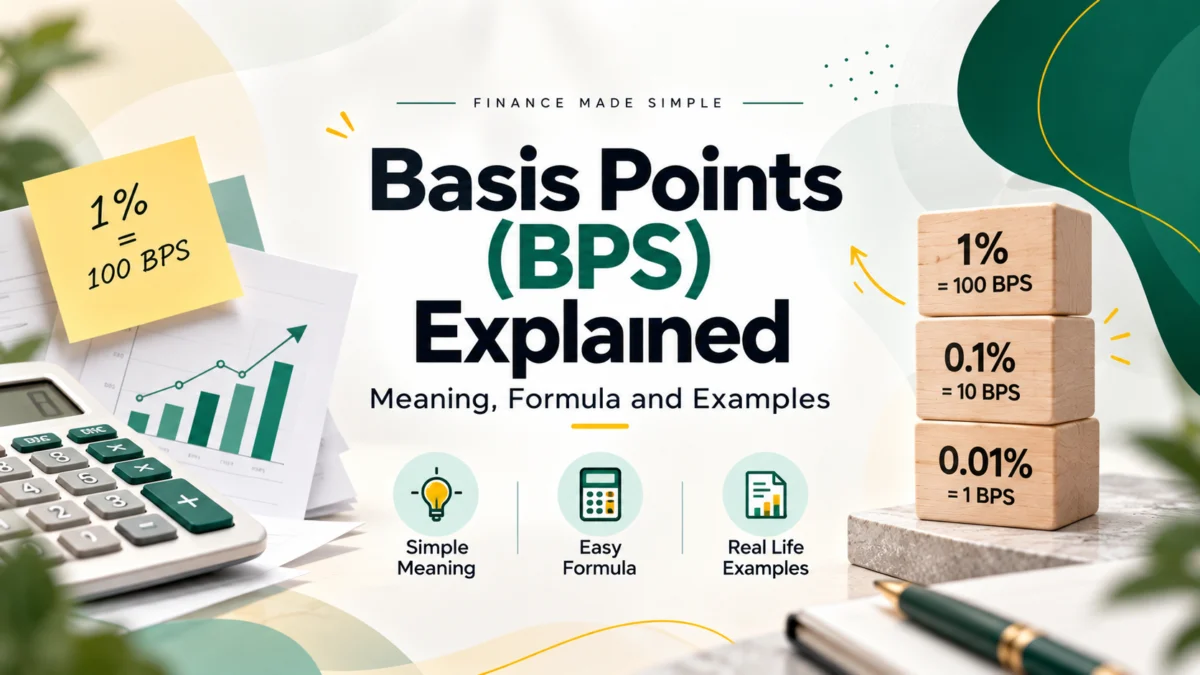
Basis points, commonly written as BPS or bps, are used in finance to describe small changes in interest rates, bond yields, loan rates, and investment fees. If you have ever read that the Federal Reserve changed rates by 25 basis points or that a fund reduced its expense ratio by 10 basis points, understanding this term can help you interpret the numbers correctly.
One basis point equals 0.01 percentage point. That means 100 basis points equal 1 percentage point. Although the calculation is simple, confusing basis points with a relative percentage change can lead to mistakes when comparing financial rates or estimating costs.
This guide explains the meaning of basis points, the BPS formula, how to convert basis points into percentages, practical financial examples, and common calculation mistakes.
Key Takeaways
- One basis point equals 0.01 percentage point, or 0.0001 in decimal form.
- 100 basis points equal 1 percentage point.
- To convert basis points to percentage points, divide by 100.
- To convert a percentage point change to basis points, multiply by 100.
- Basis points are commonly used for interest rates, bond yields, loan pricing, and investment fees.
- A change in basis points is not the same as a relative percentage change.
What Are Basis Points (BPS)?
A basis point is a unit of measurement used to express a change in a financial percentage or rate. One basis point is equal to one hundredth of a percentage point, which is written as 0.01%.
Basis points are especially useful when financial rates change by small amounts. Instead of saying that an interest rate increased by 0.25 percentage point, a financial report may describe the movement as a 25 basis point increase.
The term is often abbreviated as:
- BP: One basis point
- BPS: Multiple basis points
For example, if a loan interest rate increases from 6.00% to 6.25%, the rate has increased by 25 basis points.
Basis Points at a Glance
| Basis Points | Percentage Point Equivalent |
|---|---|
| 1 BPS | 0.01% |
| 5 BPS | 0.05% |
| 10 BPS | 0.10% |
| 25 BPS | 0.25% |
| 50 BPS | 0.50% |
| 75 BPS | 0.75% |
| 100 BPS | 1.00% |
| 250 BPS | 2.50% |
| 500 BPS | 5.00% |
| 1,000 BPS | 10.00% |
Important: The percentage equivalents in this table represent percentage points, not relative percentage changes.
Basis Points Formula
The basis points formula depends on whether you are converting a percentage into basis points or converting basis points into a percentage point value.
Formula to Convert Percentage Points to Basis Points
Basis Points = Percentage Point Change × 100
Example:
A rate increases by 0.35 percentage point.
0.35 × 100 = 35 basis points
Therefore, a 0.35 percentage point increase equals 35 BPS.
Formula to Convert Basis Points to Percentage Points
Percentage Point Change = Basis Points ÷ 100
Example:
A bank increases a rate by 60 basis points.
60 ÷ 100 = 0.60 percentage point
Therefore, 60 BPS equals 0.60 percentage point.
Formula to Calculate Basis Points Between Two Rates
When you know the original rate and the new rate, use:
Basis Points = (New Rate − Original Rate) × 100
Use the rates as percentage values, such as 5.75 and 5.25.
Example:
Original rate = 5.25%
New rate = 5.75%
(5.75 − 5.25) × 100 = 50 BPS
The rate increased by 50 basis points.
How to Convert Basis Points to Percentages
Converting basis points into percentage points requires only one step: divide the BPS value by 100.
Step by Step Conversion
Step 1: Identify the number of basis points.
Example: 125 BPS
Step 2: Divide the value by 100.
125 ÷ 100 = 1.25
Step 3: Express the result as a percentage point change.
125 BPS = 1.25 percentage points
Convert Percentages to Basis Points
To convert a percentage point value into basis points, multiply it by 100.
For example:
0.45 × 100 = 45 BPS
A 0.45 percentage point change equals 45 basis points.
Convert BPS to Decimal Form
If you need to use basis points in a financial calculation involving a dollar amount, convert the BPS value into a decimal.
Decimal Rate = Basis Points ÷ 10,000
For example:
75 ÷ 10,000 = 0.0075
Therefore, 75 BPS equals 0.75%, or 0.0075 in decimal form.
This decimal conversion is useful when estimating the effect of a rate change on a loan balance, investment, or fee.
Also Read : Cash vs Accrual Accounting: Differences, Examples
Basis Points Conversion Table
Use this quick reference table to convert common basis point values into percentage points and decimal form.
| Basis Points | Percentage Points | Decimal Form |
|---|---|---|
| 1 BPS | 0.01% | 0.0001 |
| 10 BPS | 0.10% | 0.0010 |
| 20 BPS | 0.20% | 0.0020 |
| 25 BPS | 0.25% | 0.0025 |
| 40 BPS | 0.40% | 0.0040 |
| 50 BPS | 0.50% | 0.0050 |
| 75 BPS | 0.75% | 0.0075 |
| 100 BPS | 1.00% | 0.0100 |
| 150 BPS | 1.50% | 0.0150 |
| 200 BPS | 2.00% | 0.0200 |
| 250 BPS | 2.50% | 0.0250 |
| 500 BPS | 5.00% | 0.0500 |
| 1,000 BPS | 10.00% | 0.1000 |
| 10,000 BPS | 100.00% | 1.0000 |
Quick tip: Remember that 100 BPS equals 1 percentage point. This makes it easier to estimate common rate changes without using a calculator.
How to Calculate Basis Points Between Two Rates
If you want to find the basis point difference between two interest rates, subtract the original rate from the new rate and multiply the result by 100.
Example 1: Interest Rate Increase
Suppose a loan interest rate changes from 4.50% to 5.00%.
| Detail | Value |
|---|---|
| Original Rate | 4.50% |
| New Rate | 5.00% |
| Rate Difference | 0.50 percentage point |
| Basis Point Change | 50 BPS |
Calculation:
(5.00 − 4.50) × 100 = 50 BPS
The rate increased by 50 basis points.
Example 2: Interest Rate Decrease
Suppose a savings account rate falls from 4.75% to 4.40%.
(4.40 − 4.75) × 100 = −35 BPS
The rate decreased by 35 basis points.
A negative result indicates a reduction, while a positive result indicates an increase.
Real World Examples of Basis Points
Basis points are used across several areas of finance. Here are practical examples of how they can affect rates, costs, and returns.
Example 1: Federal Reserve Interest Rate Changes
The Federal Reserve communicates changes to its target federal funds rate in percentage points. Financial news commonly describes these changes in basis points.
For example, a hypothetical 25 basis point rate increase means a change of 0.25 percentage point.
If the rate moves from 4.00% to 4.25%, the increase is 25 BPS.
A change in the federal funds rate does not automatically mean every consumer loan or savings rate will change by the same amount. Financial institutions set their rates based on several factors.
Example 2: Mortgage Interest Rate Changes
Basis points can help borrowers compare mortgage rate changes.
Suppose a mortgage rate increases from 6.25% to 6.75%.
(6.75 − 6.25) × 100 = 50 BPS
The mortgage rate increased by 50 basis points.
For a borrower, the actual change in monthly payments depends on the loan balance, repayment term, loan structure, and other costs.
Example 3: Investment Fund Expense Ratios
Investment funds may express management costs or expense ratios as a percentage of assets.
Suppose a fund’s annual expense ratio changes from 0.60% to 0.70%.
(0.70 − 0.60) × 100 = 10 BPS
The expense ratio increased by 10 basis points.
On a hypothetical $10,000 balance, a 0.10% annual fee difference equals approximately $10 per year, assuming the balance remains constant and ignoring other costs or changes in value.
Example 4: Bond Yield Changes
Bond yields often move by small percentage amounts, making basis points useful for comparing changes.
Suppose a bond yield moves from 4.20% to 4.55%.
(4.55 − 4.20) × 100 = 35 BPS
The yield increased by 35 basis points.
Bond prices and yields generally move in opposite directions, but the impact of a yield change on a particular bond depends on factors such as maturity, coupon, and market conditions.
Example 5: Loan Spread Changes
A lender may price a loan using a benchmark rate plus a spread.
Suppose a loan spread increases from 175 BPS to 225 BPS.
225 − 175 = 50 BPS
The spread increased by 50 basis points, equivalent to 0.50 percentage point.
The borrower’s total rate depends on the benchmark rate and the terms of the loan.
Also Read : Accounting vs Bookkeeping
Basis Points vs Percentage Points
Basis points and percentage points are closely related, but they are not the same unit.
A percentage point measures the arithmetic difference between two percentage values. A basis point is one hundredth of a percentage point.
| Term | Meaning | Example |
|---|---|---|
| Basis Point | 0.01 percentage point | 25 BPS = 0.25 percentage point |
| Percentage Point | Difference between two percentage values | 5.00% to 5.25% = 0.25 percentage point |
| Relative Percentage Change | Change compared with the original value | 5.00% to 5.25% = 5% relative increase |
Why the Difference Matters
Suppose an interest rate increases from 5.00% to 5.50%.
The change is 0.50 percentage point, or 50 basis points.
However, the relative increase compared with the original 5.00% rate is 10%.
These describe two different calculations. Basis points are typically used to express the absolute difference between rates, not the relative percentage change.
Why Are Basis Points Used in Finance?
Basis points make small rate movements easier to communicate and compare. They are useful when a small difference can affect borrowing costs, investment expenses, or financial returns.
1. Clearer Interest Rate Communication
Saying that a rate increased by 25 basis points communicates a precise change of 0.25 percentage point.
2. Easier Comparison of Financial Products
Borrowers and investors can compare changes in rates, fees, and spreads using the same unit.
3. More Precise Financial Reporting
Financial institutions and market analysts can describe small changes without repeatedly using decimal percentages.
4. Useful for Large Balances
Even a small rate difference can translate into a noticeable dollar amount when applied to a large balance. The actual impact depends on the balance, time period, and applicable financial terms.
Common Mistakes When Calculating BPS
Basis point calculations are straightforward, but the following mistakes can lead to incorrect interpretations.
Confusing Basis Points With Percentages
A 100 basis point change equals 1 percentage point, not a 100% relative increase.
Using the Wrong Conversion Formula
To convert BPS into percentage points, divide by 100. To convert percentage points into BPS, multiply by 100.
Ignoring the Starting Rate
A 50 BPS increase does not mean the new rate is 0.50%. It means the original rate increases by 0.50 percentage point.
For example, a rate of 4.00% that increases by 50 BPS becomes 4.50%.
Mixing Up Percentage Points and Relative Change
A move from 4.00% to 4.50% is a 0.50 percentage point increase, but a 12.5% relative increase compared with the original rate.
Assuming Every Financial Product Changes Equally
A benchmark rate change may influence loans, savings accounts, or bonds differently. The effect depends on the product and its terms.
Frequently Asked Questions
What does BPS mean in finance?
BPS stands for basis points. It is a unit used to express small changes in financial percentages and rates. One basis point equals 0.01 percentage point.
How much is 1 basis point?
One basis point equals 0.01 percentage point, or 0.0001 in decimal form.
How many basis points equal 1%?
100 basis points equal 1 percentage point.
How do you calculate basis points?
Subtract the original rate from the new rate and multiply the difference by 100. For example, a change from 5.00% to 5.25% equals 25 basis points.
How do you convert 50 BPS to a percentage?
Divide 50 by 100. The result is 0.50 percentage point.
How do you convert 100 BPS to a decimal?
Divide 100 by 10,000. The result is 0.01 in decimal form, equivalent to 1.00%.
Is 25 basis points a big change?
A 25 basis point change equals 0.25 percentage point. Whether it has a meaningful financial impact depends on the rate, balance, time period, and financial product involved.
What is the difference between BPS and percentage change?
Basis points usually describe the absolute difference between two percentage rates. Relative percentage change measures the difference compared with the original value. These calculations can produce different results.
Final Thoughts
Basis points are a standard way to describe small changes in financial rates. Knowing that 1 BPS equals 0.01 percentage point and 100 BPS equal 1 percentage point makes it easier to understand interest rate announcements, mortgage changes, bond yields, loan spreads, and investment fees.
For accurate calculations, identify the original and new rates, calculate the percentage point difference, and convert that difference into basis points. When estimating the dollar impact, use the appropriate balance and decimal rate, and account for the financial product’s terms.
Understanding BPS helps you read financial information more clearly and compare rate changes without confusing percentage points with relative percentage changes.
Also Read : What Is Bookkeeping? Definition, Types, Process